




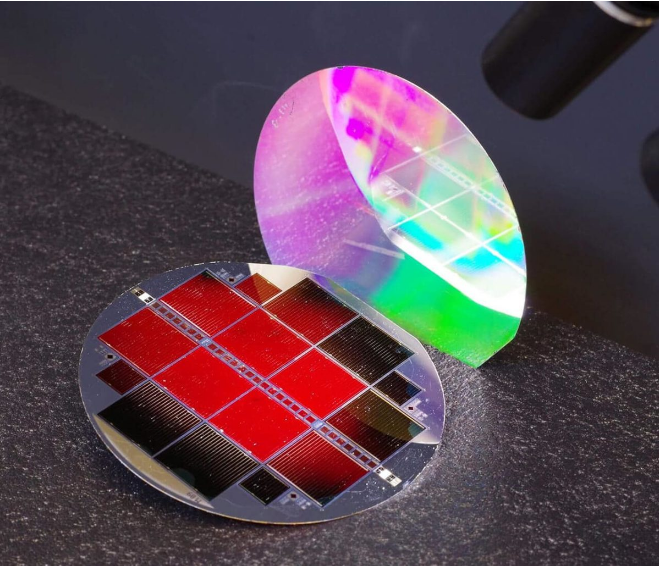
Germany’s Fraunhofer Institute for Solar Energy Systems ISE claims to have achieved a 35.9% conversion efficiency rate for a III-V monolithic triple-junction solar cell based on silicon.
“This value measured under the terrestrial AM1.5g spectrum sets a new world record and demonstrates the potential of silicon-based tandem photovoltaics,” the research institute stated.
The cell, which looks externally like a device with a two-terminal architecture, was built with III-V semiconductor layers that were connected to the silicon sub-cell on the atomic level. The key for achieving the record power conversion efficiency was the use of a semiconductor material based on gallium-indium-arsenide-phosphide (GaInAsP) for the middle cell.
“The new material allowed us to further improve the lifetime of the charge carriers and thus achieve a higher cell voltage,” said researcher Patrick Schygulla. “It’s great to see how our material development has successfully contributed to improvements in III-V//Si triple-junction solar cells.”
The scientists claim the cell may be used in electrically powered aircraft and drones.
In August, the Fraunhofer ISE achieved a 25.9% conversion efficiency rate for a III-V tandem solar cell grown directly on silicon. This cell is a modified version of a 34.5%-efficient III-V solar cell that is manufactured through a process known as direct wafer bonding, where the III-V layers are first deposited on an aluminum gallium arsenide (GaAs) substrate and then pressed together.
The cost of producing solar cells based on compounds of III-V element materials – named according to the groups of the periodic table that they belong to – has confined such devices to niche applications, including drones and satellites, where low weight and high efficiency are more pressing concerns than costs in relation to the energy produced.
Researchers at the Tampere University in Finland have recently developed a III-V multi-junction solar cell which is claimed to have the potential for reaching a power conversion efficiency of close to 50%. The National Renewable Energy Laboratory (NREL) in the United States announced last year a 32.9% efficiency for a tandem cell device utilizing III-V materials.