



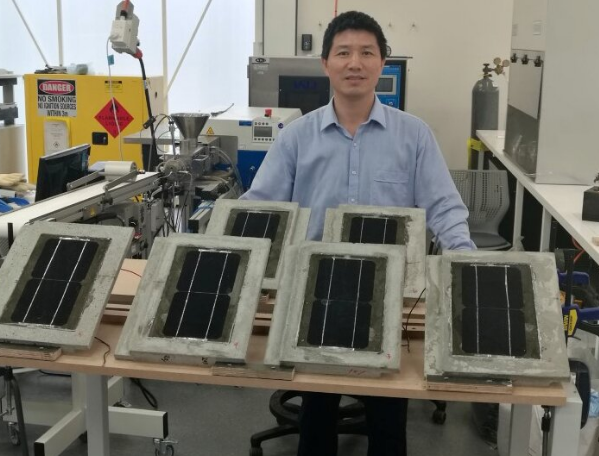
Researchers from Australia’s Western Sydney University have created a solar tile that includes phase-change materials (PCM) with a cooling function. They built the device by attaching 12.5 × 12.5 mm monocrystalline solar cells to a mortar roof tile that was doped with the PCM.
To avoid leakage issues, they created a form-stable PCM by encapsulating methyl stearate (MeSA), which is often used as an antifoaming agent and fermentation nutrient, into diatomite, which is a very fine-grained siliceous sedimentary rock used as a filtration medium.
“In making the roof tiles, the form-stable PCM was directly mixed into the mortar to enhance its thermal mass,” the scientists said. “After the roof tile was demoulded, PV cells were bonded to its top surface and then protected with a glass cover.”
They then mixed the PCM with fine sand, cement and water to build an 11 mm tile. The 17%-efficient solar cells were bonded to the tile through epoxy adhesive and then covered with another adhesive layer before installing the protective glass.
The thermal performance of the device was compared to that of a roof tile with no PV devices and a conventional solar tile with no passive cooling. Type-T thermocouples were used to measure the temperature of the three tiles at both the top and the bottom of their surface, while an Apogee pyranometer was used to measure solar irradiance.
According to these measurements and an assessment of the tile’s power yield, the PCM solar tile provided 4.1% more power than the PV tile with no cooling agent in the winter. This value ranged between 2.2% to 4.3% in the summer.
The academics also conducted an analysis to verify whether the increase in cost represented by the addition of the PCM – evaluated at around 1.2% – may justify a higher upfront investment. They found that investment return for the newly developed solar tile would be 5.7 years, compared to six years for the conventional PV tile.
“To build a robust BIPV system, further study should be conducted to choose the best PCM and optimize the PCM content, tile size and tile thickness,” they concluded. “It would further minimize the cost and maximize the tile performance.”
The scientists described their findings in “Improving performance of solar roof tiles by incorporating phase change material,” which was recently published in Solar Energy.
Solar tile with passive cooling
Researchers built the device by attaching 17%-efficient monocrystalline PV cells to a mortar roof tile that was doped with a phase-change material (PCM). The PCM solar tile provided 4.1% more power than the PV tile with no cooling agent in the winter, and 2.2% to 4.3% more during the summer.
Source:PV magazine

- Advertisment -