





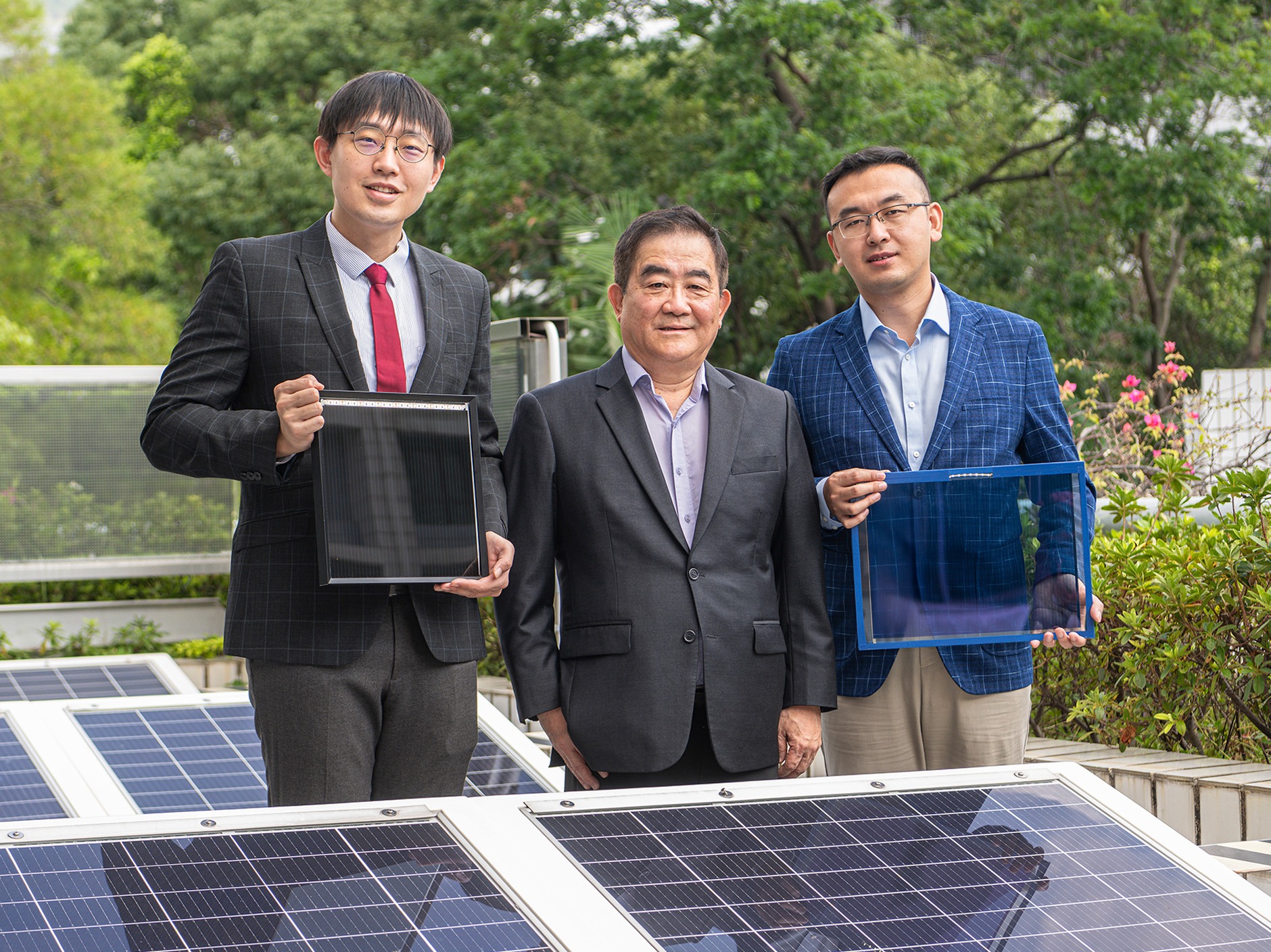
Scientists from City University of Hong Kong (CityUHK) have recently achieved a major breakthrough in the field of photovoltaic technology, successfully developing highly efficient and durable perovskite solar cells (PSCs) suitable for outdoor environments. It is expected to contribute to the wider adoption of solar power and advance global carbon neutrality goals.
The research team, led by Professor Alex Jen Kwan-yue, Lee Shau Kee Chair Professor of Materials Science at CityUHK, used molecular engineering techniques to develop an in-situ crosslinking strategy at the molecular level of self-assembled monolayers (SAMs), making the entire SAM robust and durable. Inverted PSCs made with this technique achieve state-of-the-art stability and efficiency. The research results have been published in Nature.
Previously, the instability of hole-selective SAMs in inverted PSC technology often hindered its practical applications. The inverted PSCs using this new technology not only maintain stability at temperatures as high as 85°C, meeting international industry standards, but also survive 700 cycles between -40°C and 85°C, maintaining over 98% of its initial power conversion efficiency (PCE), representing one of the best reported results.
Professor Jen stated that the PCE of the PSCs derived from applying this new technique has increased to 26.92%, with negligible decay after 1,000 hours of continuous operation at 85°C.
He explained, “When a conventional monolayer is placed on an electrode, heating or light exposure causes the monolayer to loosen, leading to the decomposition of perovskite due to directly touching the electrode. The new ‘crosslinkable co-SAM’, developed at CityUHK, not only fills the voids by introducing guest crosslinkable molecules but also undergoes in-situ crosslinking and toughening of the SAM after simple thermal activation.”
Professor Jen added that for PSCs, it has always been difficult to achieve both efficiency and stability. Dr Jiang Wenlin, a research team member said, “We meticulously studied the materials used in each layer of PSCs. By combining our expertise in organic chemistry, inorganic chemistry, optics, and device physics, we were able to solve this long-standing technical problem.”
This new technology is particularly beneficial to Hong Kong, which is densely populated with many high-rise buildings. It can be applied to make flexible, semi-transparent PSCs for solar windows or fa?ades, and these cells that can even generate electricity under indoor light to enable the development of self-powered sensors for supporting the growing popularity of the Internet of Things (IoT).
Last year, Professor Jen’s new generation of printable, high-efficiency perovskite photovoltaic modules received a significant grant in the first round of funding from the Innovation and Technology Commission’s Research, Academic and Industry Sectors One-plus Scheme (RAISe+ Scheme). The team plans to build a pilot production line with an annual output of 20 megawatts, and is currently in the final stage of site selection. Investors include Hong Kong and China Gas (Towngas) and ABES. Towngas has over 200 sites in Chinese Mainland and Hong Kong that require solar cells to support clean energy production. Professor Jen pointed out that if this new invention can be applied on a large scale, it will be a major breakthrough for the above-mentioned project and the entire printable PSCs industry.