




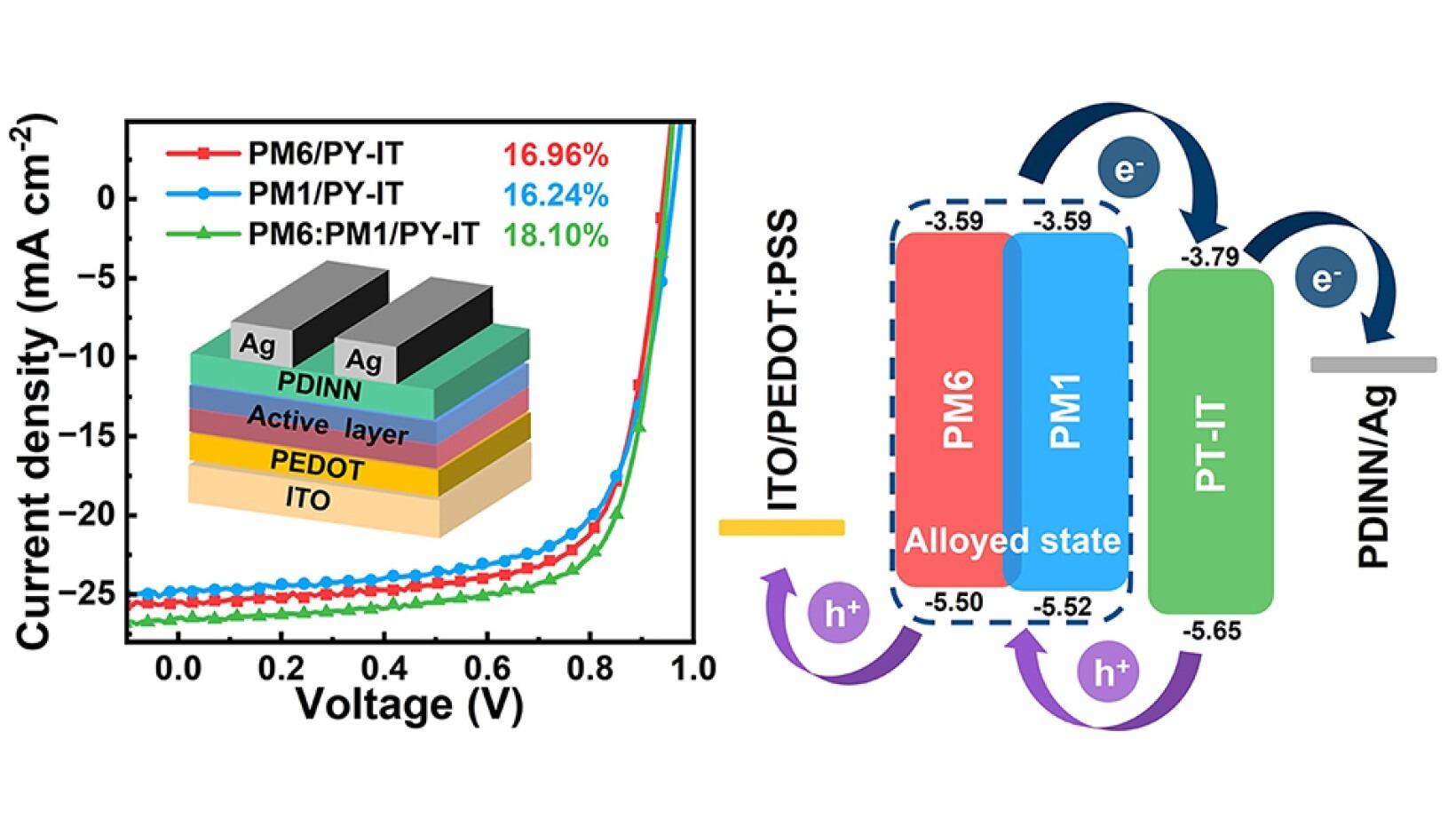
All-polymer solar cells (all-PSCs) are flexible, extensible, and stable in light and heat. However, the disrupted microscopic structure of all-PSCs compromises the solar absorption efficiency of their active or solar-absorbing layers. Dong et al. developed a method that optimizes the microstructure of all-PSCs to maximize their efficiency.
The new layer-by-layer technique enables control of the morphology of the active layer — in particular, the distribution of all-PSC phases along the vertical direction, a critical contributor to all-PSC efficiency. The authors, who built the active layer in three components — a donor and acceptor layer with a third to modulate the morphology further — found that their new morphology exhibited a higher power conversion efficiency and stability compared to all-PSCs that used only two components.
“The strong entanglement and complex intermolecular interactions of conjugated chains, alongside insufficient entropic driving force in polymer donor-acceptor systems may result in excessive phase separation and compromised molecular ordering control in the bulk heterojunction active layer of all-PSCs,” said author Qianqian Sun. “This research demonstrates that combining dual-donor ternary strategy and the layer-by-layer strategy improves the efficiency of exciton dissociation, charge transport and collection of all-PSCs and enables them to achieve high performance.”
The team used PM6:PM1/PY-IT as the active layer in their all-PSCs. This combination was chosen because PM6 and PM1 are highly compatible donor polymers that form alloy-like blends. These alloy states improve how the molecules are arranged — by making them more orderly and crystalline — and enhance the vertical layering of different phases within the material.
Sun said that using different additives, which could influence the structural arrangement of all-PSCs in other ways, may further improve the solar cells’ performance.
Source: “High-efficiency ternary layer-by-layer all-polymer solar cells enabled by a dual-donor alloy strategy,” by Ran Dong, Jie Chi, Tengfei Han, ShuLin Han, Hang Zhou, Lei Cai, Fujun Zhang, Yingying Ren, and Qianqian Sun, Applied Physics Letters (2025). The article can be accessed at https://doi.org/10.1063/5.0288803 .