





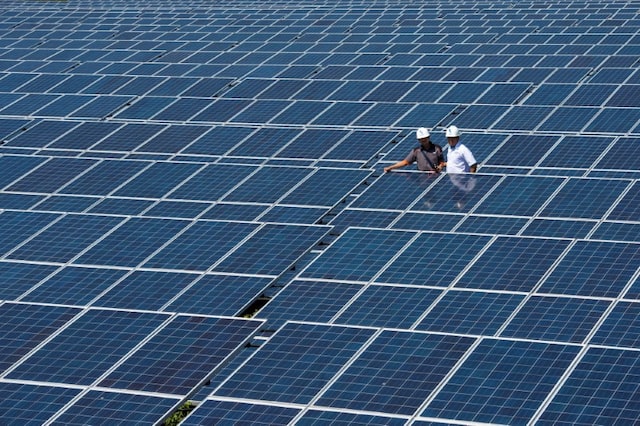
The industry association believes this will support the European solar energy market
The European Solar Manufacturing Council (ESMC) has called on the European Commission to include solar photovoltaic modules, mounting structures for aluminum and steel frames, and solar trackers in the cross-border carbon adjustment mechanism.
The ESMC believes that this will support the European solar energy market, as Chinese manufacturers who export their finished products to the EU are currently exempt from the costs imposed under the bloc’s climate policy.
The council’s response to the EC consultation notes that although a typical ground-mounted photovoltaic structure is made almost entirely of steel and aluminum—materials covered by CBAM — the system itself is not currently covered by the mechanism due to certain characteristics.
The ESMC argues that this creates a critical asymmetry. European solar manufacturers who import steel and aluminum for domestic production are required to purchase CBAM certificates, while Chinese manufacturers are exempt from these costs when supplying finished solar products to the bloc.
“As a result, Chinese-made modules imported into Europe receive a free pass on embedded carbon, giving them a price advantage over solar modules manufactured in the EU,” the council said in a statement.
The ESMC points out that this loophole undermines fair competition and contradicts the main objective of the CBAM, namely to prevent carbon leakage.
According to the response, extending the mechanism to solar energy products is practical and feasible. The industry already carefully documents emissions in its supply chain, and almost all manufacturers of photovoltaic systems have verified third-party assessments of the life cycle of their products (through environmental declarations or the French Certisolis).
The association believes that extending CBAM to solar energy products manufactured in subsequent stages will also be in line with the EU’s broader climate goals, eliminate an accidental gap in carbon pricing, and ensure the fairness of the mechanism.
In addition, the ESMC proposes adopting special customs codes for solar mounting systems and trackers, which would facilitate the application of CBAM to these products.
As a reminder, the European Commission has confirmed that the carbon border adjustment mechanism will be implemented on schedule, starting January 1, 2026. The Directorate-General for Taxation and Customs Union (DG TAXUD) provided the relevant clarification in response to a request from the Eurometal association.