




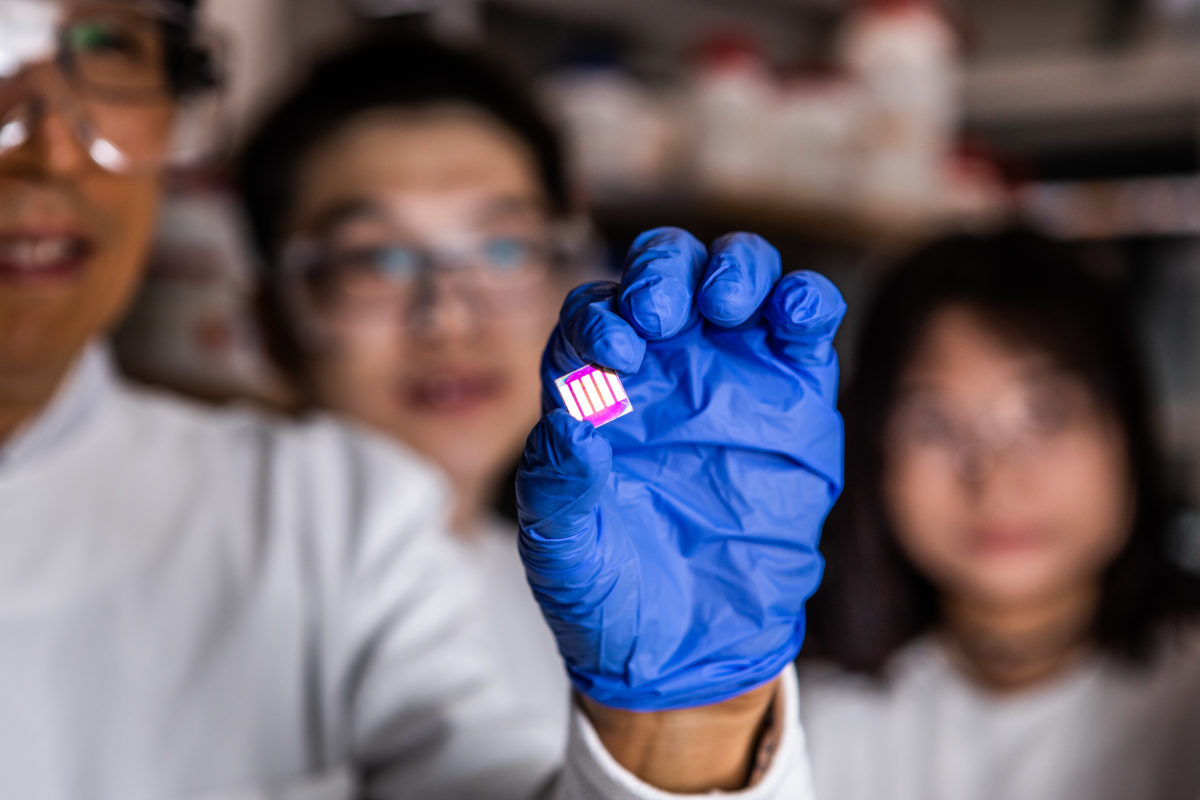
Quantum dots – nanoparticles of semiconductor material able to carry a charge, have been investigated for their solar cell potential in various materials for at least a decade and have made impressive progress since the first reported cell efficiency for the technology – 2.7% in 2010.
This week, scientists at the University of Queensland (UQ) took another step forward with the technology. The group achieved 16.6% efficiency by synthesizing a quantum dot solar cell from a halide perovskite, improving on the record for such a device by almost 25% (relative efficiency). The measurements were confirmed at Newport PV Lab in Montana in the U.S., and verified by the U.S. National Renewable Energy Laboratory (NREL).
“The near-25% improvement in efficiency we have achieved over the previous world record is important,” said Lianzhou Wang, director of the Nanomaterials Centre at the University of Queensland. “It is effectively the difference between quantum dot solar cell technology being an exciting ‘prospect’ and being commercially viable.”

The NREL set the previous record for quantum dot cell efficiency in 2017 at 13.4%, working with a similar lead halide perovskite. The record-breaking new Australian cell is described in the paper Ligand-assisted cation-exchange engineering for high-efficiency colloidal Cs1−xFAxPbI3 quantum dot solar cells with reduced phase segregation, published in Nature Energy.
A surface engineering strategy that enabled the Queensland team to better control the synthesis of the quantum dot material and overcome previous challenges of roughness and instability was crucial, according to the researchers. The cell retained 94% of its initial efficiency after 600 hours under constant one-sun illumination and the group said it expects to be able to report even longer device lifetimes in the near future.
Flexible solution
Although the cell was produced in lab conditions and deposited on a glass substrate, Wang and his colleagues were keen to point out the material’s potential for production in a low-cost, room-temperature printing process, as well as for integration with flexible substrates.
“Compared to other emerging PV technologies, such as perovskite thin-film solar cells, the QD [quantum dot] PV technology developed at UQ has the advantage of colloidal [evenly distributed] synthesis and industrially-compatible processing at room temperature,” said Yang Bai, key researcher at the University of Queensland Nanomaterials Centre. “This enables more convenient and rapid manufacturing by decoupling grain crystallization from film deposition.”
The group has suggested the material could be useful in flexible applications. “The cell was fabricated on a conductive glass substrate,” said Bai. “We are currently working on [a] flexible substrate and it seems easier to maintain the high quality of QD films on [a] flexible substrate compared to other thin-film PV technologies.”
Bai added, the university is working on scaling up its quantum dot technology with a large scale printing process and said his group will focus on pushing efficiency even higher. “There is still plenty of room to further explore in this emerging QD photovoltaics field,” he said. “Efficiency over 20% will be the next target for our group.”