





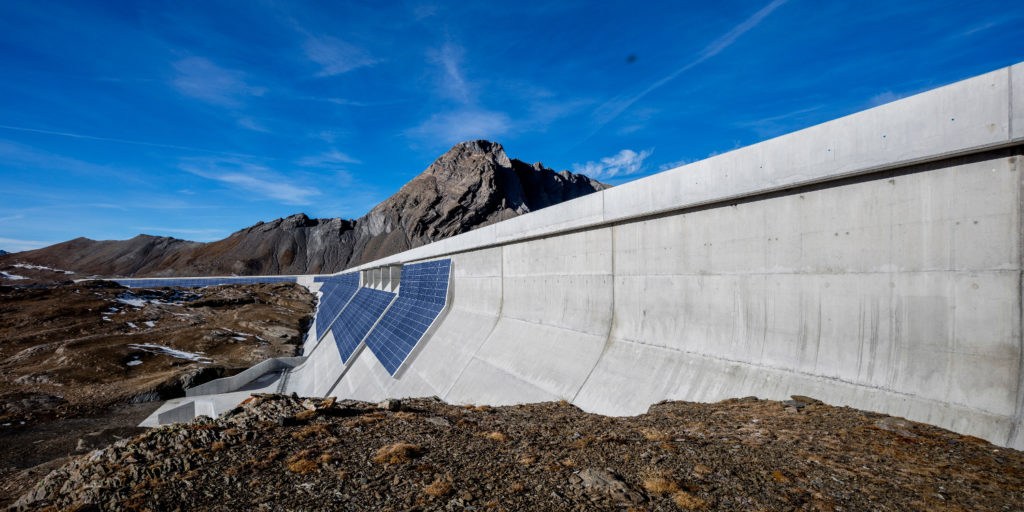
In November, Axpo presented plans to build the first alpine PV plant in Switzerland. The 2 MW system will be built on the Muttsee dam, at an altitude of almost 2,500 meters above sea level.
The authorities in the canton of Glarus finally approved the project on Wednesday, in cooperation with the municipality of Glarus Süd and the Swiss Federal Office of Energy.
Axpo said that it will now try to build and commission the plant by the summer of 2021. However, it is still trying to clarify financing arrangements, said Christoph Sutter, head of new energy at Axpo.
“We are in negotiations with companies who are interested in purchasing the Muttsee plant,” he explained, noting that Axpo will make a final decision on when the project will be built at some point later this year.
Yields from PV system at high altitudes appear promising, with the potential to generate around 2.7 GWh of solar power. Axpo has also conducted recent studies on wind and snow loads.
Researchers at the Swiss Institute for Snow and Avalanche Research (SLF) recently concluded that high snow loads could occur. This could affect the foot of the wall, where snow will accumulate. In order to avoid long-term damage to the solar modules, Axpo will need to slightly adapt its system design. A total of around 6,000 solar modules will be installed on an area of 10,000 square meters.
Over the next few weeks, the company also plans to apply to add the system to a list of lighthouse projects under the Federal Office of Energy. But before that happens, a decision needs to be made about the specific design of the PV system. The initial plan was to install the upper module level at an incline of 77 degrees and the lower one at 51 degrees. The grid connection for the project is already in place for the south-facing dam.
Axpo expects the PV system to deliver around half of its electricity production in the winter months. High altitudes offer the advantage of less fog and more sunlight. The efficiency of the modules is also higher at lower temperatures.
In addition, the bifacial effect is enhanced by snow cover in the winter, as Axpo explained in November. It therefore hopes that the project will help to address winter electricity shortages in Switzerland.