





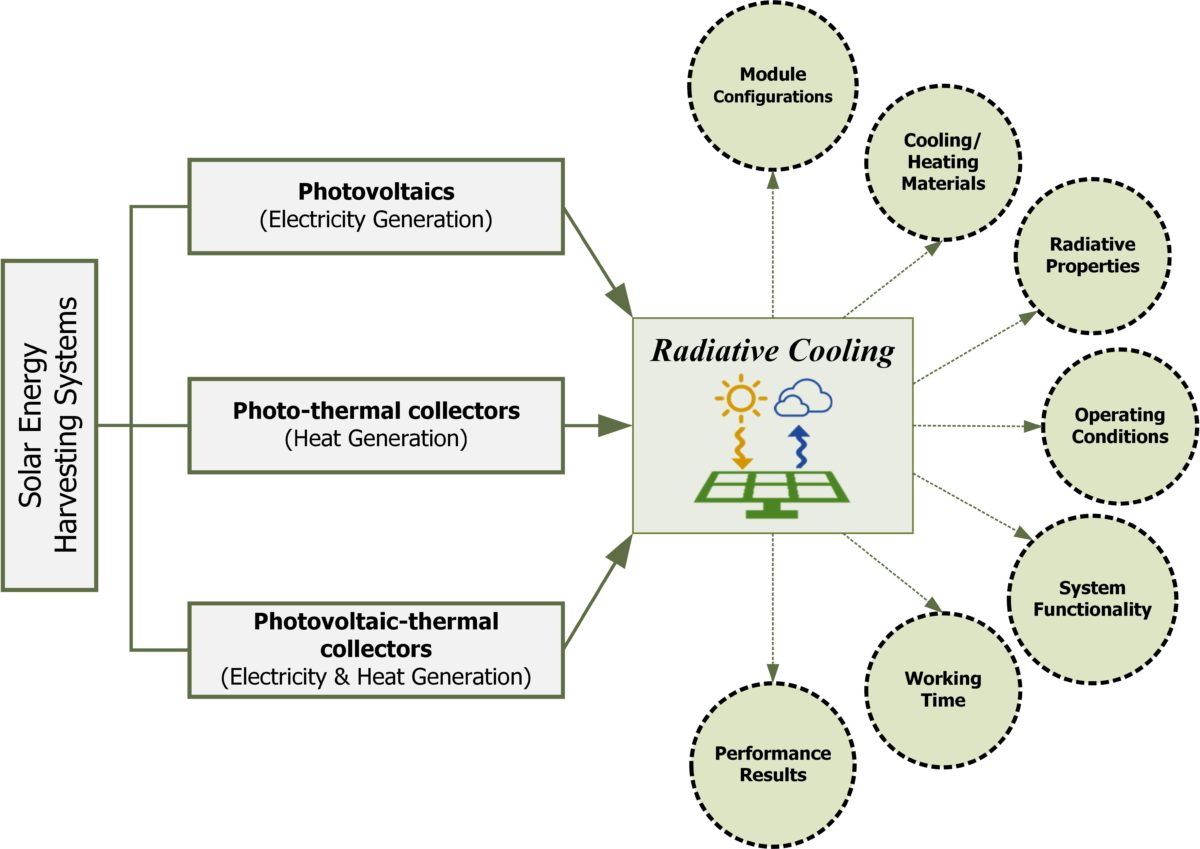
Researchers at the Shanghai Jiao Tong University in China have conducted a review of the possible combinations between radiative cooling (RC) techniques and solar energy systems of different kinds and have found that a series of challenges must still be addressed to bring this combination closer to commercial maturity. “We are examining the feasibility of employing radiative cooling to reduce PV panel temperature and thus increase PV power generation,” the author Dr. Tao Ma, told pv magazine. “On the other hand, radiative cooling could also be used for other solar energy systems, such as solar thermal installations or concentrated solar (CPV) systems.”
Dr. Ma also explained that the cost of a radiative cooling system was not considered in the study.” But generally, it is very cheap, and some scientists are developing some radiative materials with low price and high performance.”
In the paper A review on the integration of radiative cooling and solar energy harvesting, published in materialstoday Energy, Dr. Ma and his colleagues explained that, compared to conventional cooling techniques, radiative cooling is more environmentally friendly as it does not dump the waste heat into the atmospheric air or local water bodies, and, as a passive technique, does not take require any input energy.
“It can be observed that individual RC systems and solar energy systems, both undergo similar challenges in terms of insufficient output energy gain, economic issues, and limited working time,” the Chinese group explained. “It would be of particular interest if the functioning of individual systems could be integrated into a combined system that could provide enhanced output energy and function during both day and night.” Under this configuration, the two systems would not only become able to produce a higher energy gain per unit area but also increase their respective useful working time.
In their review, the academics analyzed all studies that investigated the combination of the two systems from different perspectives and identified five major system typologies based on functionality and working time. They also analyzed the possibility of replacing the modules’ glass cover with highly emissive RC materials and different types of materials including nanoparticle-based polymers, multilayered film stacks, and micro/nanopatterned structures.
“Solar energy and radiative cooling systems have great potential and promising applications, but the major challenges to large-scale development include low cooling power and heat transfer, non-uniform operating conditions, and variation in supply and demand,” the scientists stated.
RSC occurs when the surface of an object absorbs less radiation from the atmosphere and emits more. As a result, the surface loses heat to the outer space and a cooling effect can be achieved without the need for power.
Radiative cooling was recently applied to solar panel cooling by researchers from the Purdue University in the United States, the Catalan Institute of Nanoscience and Nanotechnology and the Instituto de Ciencia de Materiales in Spain, and the Jordan University of Science and Technology and the Australian College of Kuwait.