




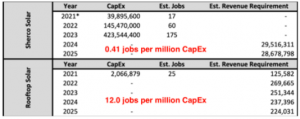
In an interesting finding, the Minnesota Public Utilities Commission has learned that for every million dollars the state’s utility proposed on spending on rooftop solar, it would create 30 times more jobs than $1 million spent on utility-scale solar.
According to the Institute for Local Self-Reliance (ILSR), in late 2020, the Minnesota Public Utilities Commission asked the state’s electric and gas utilities Xcel Energy about their infrastructure projects in the pipeline to be accelerated to support the COVID-battered economy.
In its proposal form, Xcel Energy presented a comparison between two proposed solar projects: one, a giant solar array on a closing coal plant site, and a small collection of rooftop solar projects to serve low-income residents.
A nondescript table revealed the relative economic benefits of small-scale solar. For every million the utility proposed spending on rooftop solar, it would create 30 times more jobs than $1 million spent on utility-scale solar.
ILSR, who is currently co-running a ‘30 Million Solar Homes’ campaign, has (preliminarily) found that an investment in solar for one in four American households could have $30 billion per year in energy bill savings, create over 1.7 million jobs, and shift more than 5% of total electricity use to the sun.
However, the low-income rooftop solar proposal raises an interesting question about the utility-scale project: If rooftop solar produces, by Xcel Energy’s estimates, 30 times as many jobs per million dollars of project cost, why isn’t the state doing more rooftop solar for economic recovery?
If Xcel Energy spent $608 million supporting rooftop solar, it would create over 7,000 jobs at a time with high unemployment, especially among African Americans.
According to ILSR, utility companies often and erroneously compare large and small solar costs to generate electricity, leaving out the delivery costs, not including the cost of large projects (and that small projects do not pay).
Rather, large-scale solar competes with other large-scale power production and small-scale with other sources that deliver power to homes and businesses, and both types of solar are competitive.
Minnesota’s value of solar calculation shows that rates of locally produced power are similar to the retail electricity rates. Large-scale wind and solar are the most cost-effective new electricity sources than other big power generation just about anywhere.
ILSR report further suggests that the more money the state invests in small-scale solar, the larger economic multipliers it will see across the economy. A focus on distributed solar can deliver a much bigger economic boost than allowing the utility centralized power production and competitive price.
Last year, the US clean energy industry ended with the lowest number of workers since 2015 due to the impact of the Covid-19 pandemic, according to a recent report by BW Research Partnership.
Meanwhile, the second Covid-19 surge is wreaking havoc in India, with cases surpassing six figures daily. Reports suggest that some migrant workers across the country may be making their way home to avoid the logistical nightmare a lockdown may bring. As the health crisis threatens to get out of control, Mercom took an in-depth look at what is transpiring on the ground to understand the situation at various project sites across the country.
Huge Employment Opportunity in Rooftop Solar
For every million the utility proposed spending on rooftop solar, it would create 30 times more jobs than $1 million spent on utility-scale solar
Source:MERCOM

ViaRahul Nair
- Advertisment -