





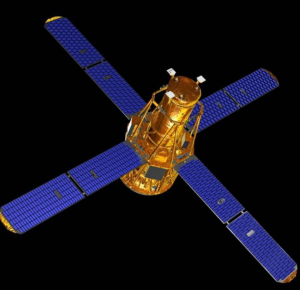
NASA’s retired Reuven Ramaty High Energy Solar Spectroscopic Imager (RHESSI) spacecraft re-entered Earth’s atmosphere at 8:21 p.m. EDT on Wednesday, April 19, almost 21 years after its launch. From 2002 to its decommissioning in 2018, RHESSI observed solar flares from its low-Earth orbit, helping scientists understand the underlying physics of how such powerful bursts of energy are created.
The Department of Defense confirmed that the 660-pound spacecraft re-entered the atmosphere over the Sahara Desert region, at approximately 21.3 degrees north latitude and 26 degrees east longitude. NASA expected most of the spacecraft to burn up as it traveled through the atmosphere, but for some components to survive re-entry.
The spacecraft launched aboard an Orbital Sciences Corporation Pegasus XL rocket with a mission to image the high-energy electrons that carry a large part of the energy released in solar flares. It achieved this with its sole instrument, an imaging spectrometer, which recorded X-rays and gamma rays from the Sun. Before RHESSI, no gamma-ray images nor high-energy X-ray images had been taken of solar flares.
Data from RHESSI provided vital clues about solar flares and their associated coronal mass ejections. These events release the energy equivalent of billions of megatons of TNT into the solar atmosphere within minutes and can have effects on Earth, including the disruption of electrical systems. Understanding them has proven challenging.
During its mission tenure, RHESSI recorded more than 100,000 X-ray events, allowing scientists to study the energetic particles in solar flares. The imager helped researchers determine the particles’ frequency, location, and movement, which helped them understand where the particles were being accelerated.
Over the years, RHESSI documented the huge range in solar flare size, from tiny nanoflares to massive superflares tens of thousands of times bigger and more explosive. RHESSI even made discoveries not related to flares, such as improving measurements of the Sun’s shape, and showing that terrestrial gamma-ray flashes – bursts of gamma rays emitted from high in Earth’s atmosphere over lightning storms – are more common than previously thought.
After 16 years of operations, NASA decommissioned RHESSI due to communications difficulties with the spacecraft. RHESSI was a NASA Small Explorers mission, managed and operated by the agency’s Goddard Space Flight Center in Greenbelt, Maryland.