




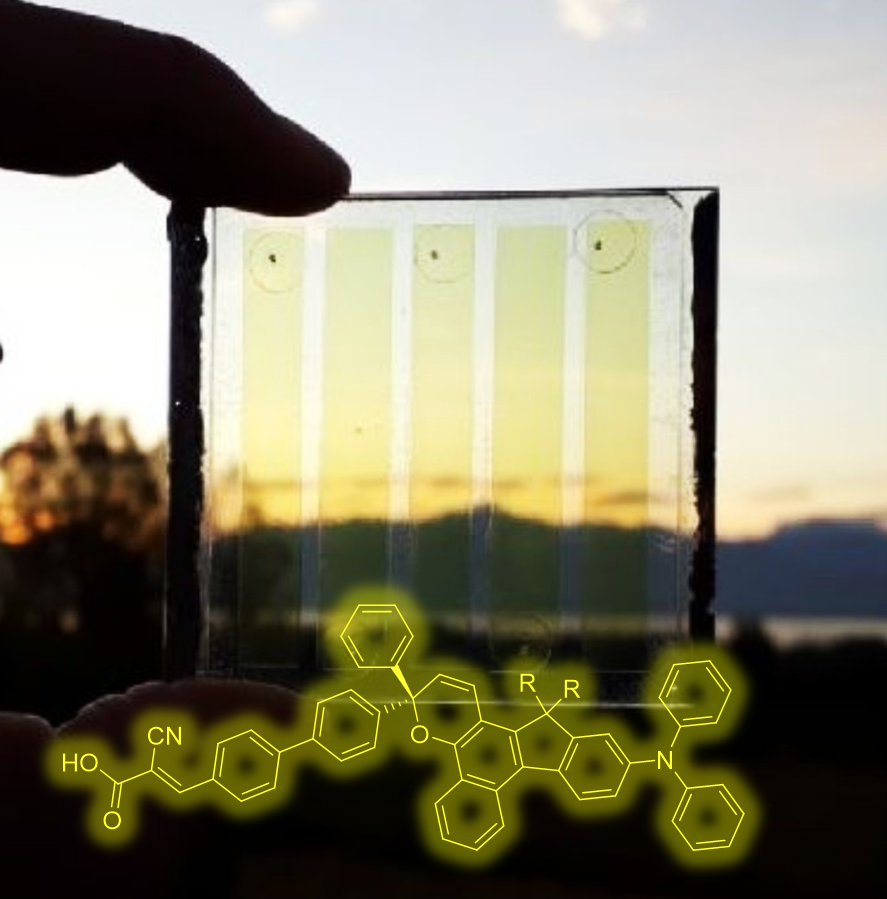
Researchers from the Interdisciplinary Research Institute of Grenoble (IRIG), a branch of France’s Commissariat à l’énergie atomique (CEA) – in collaboration with the University Pablo de Olavide in Spain and Swiss start-up Solaronix – have designed 3.68%-efficient solar panels in variable colors. They claim the panels can dynamically self-adjust their optical transmittance according to sunlight intensity.
The mini panels offer power output 32.5 milliwatts after coloration and are based on five 4.17%-efficient rectangular-shaped solar cells, interconnected in series using a W-type design, covering 61% of the total module area. In the W-type architecture, the inter-distance between cells can be smaller due to the absence of vertical interconnects.
“We choose W-type design because it is easier to fabricate,” research author, Renaud Demadrille, told pv magazine. Despite a relatively small active area of just 14 cm², the panels’ power output is considered sufficient to operate low-consumption electronic devices and sensors.
In the cells, the scientists replaced the commonly used organic dyes with photochromic dyes based on diphenyl-naphthopyran. These dyes are uncolored in the dark and can become colorful when exposed to light.
“We focused our investigations on the diphenyl-naphthopyran photochromic dyes because they fulfil the latter criterion and possess relatively high fatigue resistance and a good photo-colorability,” the research group explained.
When exposed to sunlight, the solar cells can vary their color and self-adapt their visible light transmission from 59% under low radiation levels to 27% under high radiation. At the same time, they can also generate photocurrent, up to a maximum of 12.59 milliamperes per cm², when the solar cells are fully colored.
“For the integration of semi-transparent devices in buildings, ideally solar cells should generate electricity while offering the comfort for users to self-adjust their light transmission with the intensity of the daylight,” Demadrille explained. “The self-adjusting feature can help mitigate the amount of light, when the deviced is exposed to full sun, and the temperature of building with large windows and or glass facades.”
The group tested the photochromic behavior of the first cell prototypes over a period of 10 months, without any encapsulation. At the end of this period, the cells still exhibited photochromic and photovoltaic behavior, while retaining 20% of their initial conversion efficiency.
“The performance and stability of these photochromic dye-sensitized solar cells need some improvements, but the technology has some promise due to the prospect of substantially lower production costs,” Demadrille stated.
The researchers describe the mini panels in Photochromic dye-sensitized solar cells with light-driven adjustable optical transmission and power conversion efficiency, recently published in Nature Energy.