




Singlet fission is the quantum mechanics that could allow breaking the theoretical barrier for the efficiency of silicon photovoltaic cells. It consists of a photophysical process in molecules and molecular aggregates, whereby a singlet exciton generated by irradiation splits into two triplet excitons, which means a single photon, or particle of light, can generate two electron-hole pairs as it is absorbed into a solar cell rather than the usual one.
A group of scientists from Australia’s University of New South Wales (UNSW) are working to integrate singlet fission into conventional crystalline silicon (C-Si) solar cells. “The ultimate efficiency for limit singlet fission PV was determined in 2012 by Tim and Murad [Timothy W. Schmidt and Murad J. Y. Tayebjee], both co-authors of the present study, at 45.9%,” UNSW Professor Nicholas Ekins-Daukes told pv magazine. “Realistically on silicon, we would like to achieve efficiencies above 30%.”
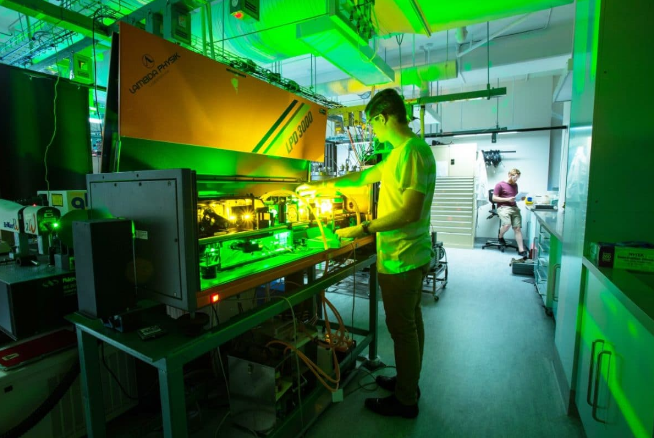
The cell behavior was analyzed at the UNSW’s Tim Schmidt’s lab
Image: University of New South Wales (UNSW)
The group claims to have discovered that singlet fission enhanced solar cells may not only provide higher energy yields compared to traditional crystalline silicon solar cells but also have lower operating temperatures and lower degradation levels. In the paper Singlet fission and tandem solar cells reduce thermal degradation and enhance lifespan, published in Progress in Photovoltaics, the researchers demonstrate spectroscopically the key advantages that both tandem cells and singlet fission cells may have in terms of temperature behavior and lifespan. The degradation of singlet‐fission layers, on the other hand, has been considered for decades one of the main challenges for the development of commercially viable solar cells based on this technique.
The scientists analyzed the performance of a perovskite/silicon tandem solar cell and a singlet fission device based on tetracene, which is a polycyclic aromatic hydrocarbon known for being able to generate triplet excitons that are energetically matched to the silicon bandgap. “While considerable efforts are underway to identify stable alternatives, tetracene is currently the only singlet fission material to have demonstrated energy transfer into silicon,” the study notes. “Importantly, ditetracene (the degradation product of tetracene under oxygen‐ and water‐free conditions) is transparent to solar radiation.”
Prof. Nicholas Ekins-Daukes
Image: University of New South Wales (UNSW)
The Australian group explained that the advantages of the technique would remain even if degradation of singlet‐fission layers occurs, as it would not affect their transparency and the solar cells would return to their usual performance levels but having gained the benefits of improved energy yields for the stable duration of the tetracene layer.
“Since the degradation product of tetracene singlet fission film is transparent to solar radiation, it will revert to standard c‐Si solar cells after the ‘benign’ degradation process, and the temperature and efficiency of tetracene singlet fission/Si module converges to that of the conventional c‐Si module,” the study emphasizes.
The singlet fission cell was made with a single molecular film and an interlayer deposited on the front of a conventional silicon solar cell. It is claimed to be able to operate at lower temperatures than the conventional C-Si cell for the first five years of operation.
When asked about the costs of the proposed technique, Ekins-Daukes said there was the opportunity to build devices based on a single molecular layer that is carefully deposited on a silicon PV cell, similar to the silicon tandem cell architecture. “It is too early to say whether this approach will be more cost-effective than a silicon tandem cell but, as we discuss in the paper, there are strong reliability advantages to the approach.” The new technology could build upon the huge investment made in silicon cell manufacturing and could be utilized in space-limited situations, like on solar electric vehicles. “Their enhanced behavior in the higher energy part of the spectrum also makes them ideal for situations with attenuated red and infrared light,” Ekins-Daukes further explained.
Several research projects have been conducted in recent years on singlet fission applied to photovoltaics, including work from the Advanced Science Research Center at the Graduate Center of the City University of New York, the Massachusetts Institute of Technology (MIT), and the U.S. National Renewable Energy Laboratory (NREL).