





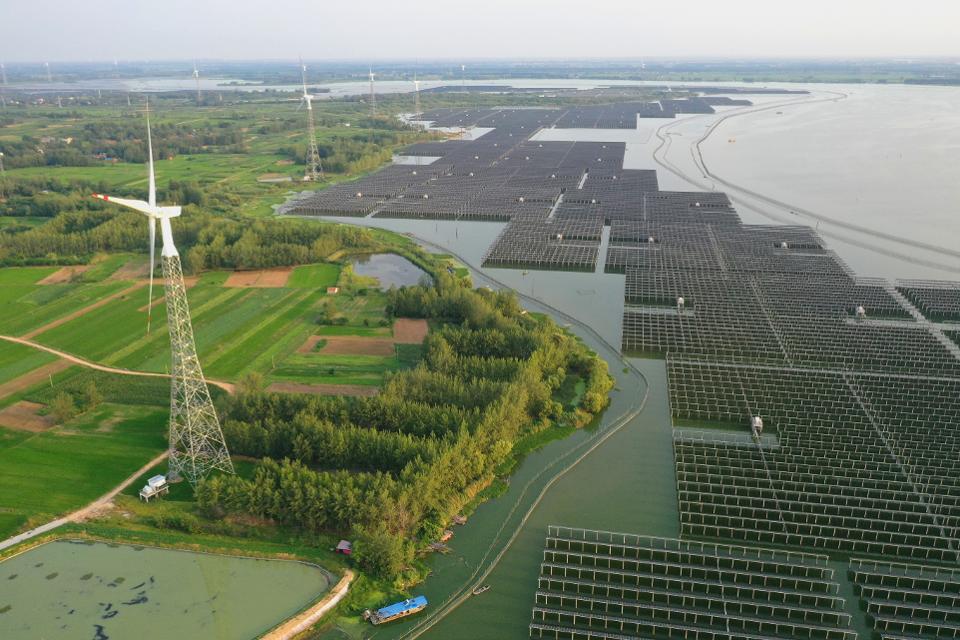
As China shuttered industries during its coronavirus lockdown in January and February, every form of energy production dropped from prior-year performance but one.
Solar was up 12 percent.
“In terms of varieties, thermal power and hydropower declined significantly, nuclear power and wind power declined slightly,” reported China’s National Bureau of Statistics, “and solar power generation grew steadily.”
The Bureau neither explained nor speculated why, but at least one analyst had predicted it:
“On the power supply side, we believe baseload generation resources such as coal, nuclear, and gas-fired combined heat and power (CHP) will be weaker than expected—with coal plants impacted the most in operation hours,” wrote Xizhou Zhou, vice president for global power and renewables at IHS Markit, in a Feb. 19 assessment of the impact of the lockdown.
“Renewable generation volume will unlikely be affected significantly due to their non-dispatchability and preferential status in the Chinese power system,” he wrote.
Zhou’s predictions were somewhat borne out in the Bureau’s March 17 report, which compared energy production in January and February to the same period a year before:
• Overall electricity production was down 8.2 percent.
• Thermal power—dominated by coal—plunged 8.9 percent, hydropower by 11.9, nuclear by 2.2.
• Wind was slightly down 0.2 percent.
• While solar was up 12 percent.
Lauri Myllyvirta, lead analyst for the Centre for Research on Energy and Clean Air, believes renewables were protected “above all” by their zero marginal cost. Every additional unit of thermal energy requires the producer to buy additional fuel. The sun demands no such payment.
China reportedly added 30 GW of solar capacity in 2019, enough that it produced 15 percent more solar energy in December 2019 than December 2018. So the January and February totals could mean that solar remained near its new status quo. If the lockdown dented solar, the dent was relatively slight.
Wind may have stayed close to what may be emerging as its new status quo as well. Its growth has lately stalled in China, only slightly up in December from the prior December, slightly down in January and February.
So it appears that China, faced with plunging demand, kept the renewables buzzing and turned down everything else.
China’s lockdown began Jan. 23 and started to ease at the beginning of March. The European Space Agency’s Copernicus Sentinel-5P satellite documented the drop in industrial emissions during that period.
The lockdown affected 27 days of the two-month period covered in the Bureau’s report, so reductions during lockdown were probably twice as dramatic as the numbers indicate, Myllyvirta tweeted.
That means energy demand dropped more like 16 percent, as cement demand declined 30 percent, manufacturing 40 percent, real estate sales 40 percent and construction starts 44 percent.
“The main point from this is that the impacts on the economy seem profound and things will not just ‘return to normal,’” Myllyvirta wrote. “They never do after a crisis.”