




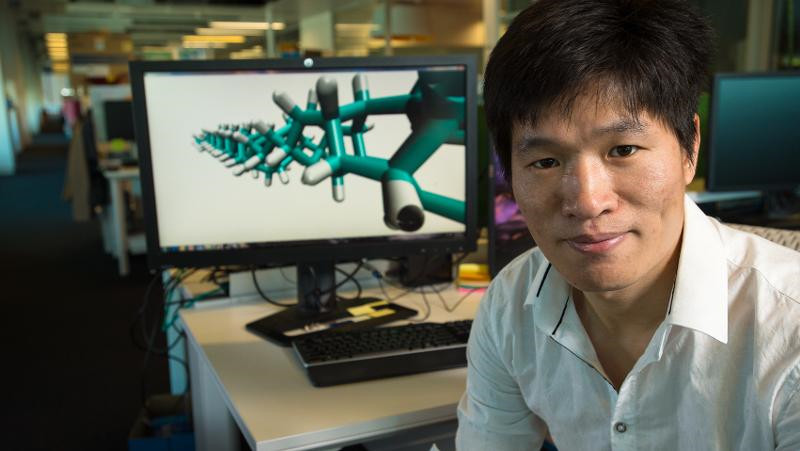
Scientists at the Queensland University of Technology’s (QUT) Centre for Materials Science have published a new research paper in Nature Communications that proposes the use of diamond nanothread bundles (DNT) to provide energy storage capabilities that could revolutionize mechanical and biomedical engineering.
DNT is a carbon nanostructure – a collection of ultra-thin, one-dimensional carbon threads that can store energy when they are twisted or stretched. QUT researcher Dr. Haifei Zhan, who is leading the research team, has likened the nanostructures to a compressed coil or children’s wind-up toy. He said that “energy can be released as the twisted bundle unravels.”
The trick involves controlling the energy that is produced. If said energy can be stabilized, it could be utilized for a range of applications, from biomedical monitoring systems to nano-robotics, and also mechanical energy storage.
“Unlike chemical storage such as lithium-ion batteries, which use electrochemical reactions to store and release energy, a mechanical energy system itself would carry much lower risk by comparison,” said Zhan.
Mechanical energy storage does not carry the risk of malfunctioning at extreme temperatures, nor the risk of chemical pollution. The stability and safety of the nanothreads is not surprising when one remembers that they’re essentially diamonds – the strongest material we know.
Of course, the diamantine nature of the structure means that it is exceedingly strong, stiff, and light. Armed with those qualities, DNT’s potential is limited only by the imagination of science-fiction writers. Now, this may be beginning to sound like an elevator pitch, and that’s exactly what it is – a space elevator pitch. The famous idea of a planet-to-space transportation system – first proposed in the late 19th century – is touted as a possible application of DNT, along with the more down-to-earth idea of more efficient electric vehicles. Either way, the sky is not the limit.
Energy density
The energy storage potential for DNT is startling. Taken pound for pound, the energy density of DNT – which is to say, how much energy it can store for its mass – was 1.76 MJ per kilogram, or three times higher than lithium-ion batteries.
“The nanothread bundles could be used in next-generation power transmission lines, aerospace electronics, field emission, batteries, intelligent textiles, and structural composites such as building materials,” Zhan said.
The researchers have an idea, but now they have to put it into action. Over the next two to three years, the QUT team plan to construct the control system in order to test the twisting and stretching of the nanothread.