




India has pledged to have 500GW of renewable capacity, accounting for 50% of its energy mix, by 2030.
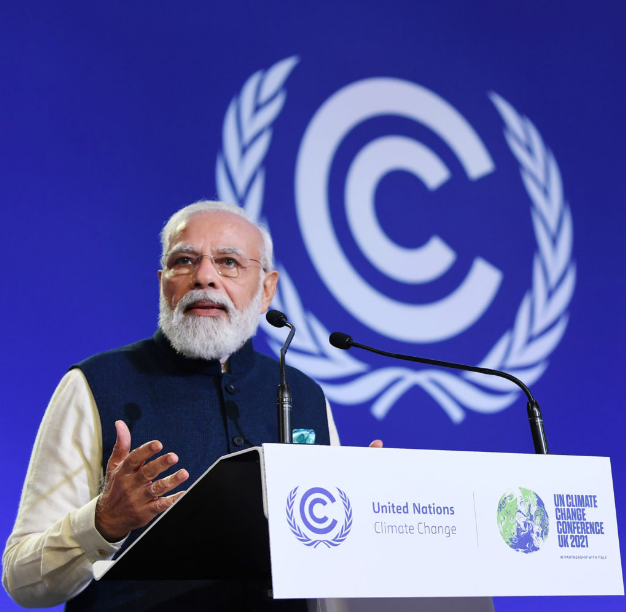
The country’s Prime Minister, Narendra Modi, speaking at the crucial COP26 climate summit in Glasgow, also said India will reach net zero by 2070, two decades later than the summit’s stated goal of 2050.
Modi made five pledges to COP26: Net zero by 2070; 500GW of renewables by 2030; meeting 50% of its energy needs through clean energy by 2030; reducing projected carbon emissions by one billion tonnes by 2030; and reducing the carbon intensity of its economy by 45% by 2030.
Vinay Rustagi, managing director at analyst firm Bridge to India, said that given the 500GW target includes both large hydro and nuclear power, it is broadly the same as previous commitments – India had already announced a target of 450GW of renewables by 2030.
“Before assessing achievability of this target, we should evaluate progress on the current 175GW target for 2022,” said Rustagi. “We expect that India will miss this target by about 35%. There are a number of demand and supply related factors behind failure to meet this target and unless urgent decisive action is taken, the story is likely to repeat in 2030.”
Rusatgi said the main barriers to India reaching this target were land and transmission infrastructure, availability of domestic manufacturing and grid integration.
“India has clearly put the ball in the court of the developed world,” according to Arunabha Ghosh, CEO of the Council on Energy, Environment and Water (CEEW), a leading India-based climate thinktank.
India has long maintained that it is the responsibility of western nations to act sooner on climate change given historic imbalances and India’s per capita emissions that make it a far smaller polluter than many western states.
Rustagi said two reasons likely informed the 2070 net zero target: India’s growing energy needs are expected to keep rising for a long time as the economy expands; and lower income levels means consumers won’t pay high energy prices, meaning India will wait for the price point to come down.
“Progress is therefore inevitably going to be slower than in the developed countries,” he said.
While the net zero date may be disappointing for western governments and climate activities, it is broadly in line with what most climate analysts believe in the soonest India can reach net zero, with the CEEW pointing to 2070 as the most realistic scenario.
COP26: India commits to 500GW of renewables by 2030, net zero by 2070
India’s Prime Minister, Narendra Modi, has committed to achieving net zero by 2070.
Source:PVTECH

- Advertisment -