





oyal Mail rolls out 3,500 solar-powered postboxes, pairing clean energy with parcel returns to support its net zero delivery & fleet decarbonisation goals
The case for clean energy grows more urgent each year. In 2024, the global average temperature reaches 1.55°C above pre-industrial levels, according to the World Meteorological Organization.
The shift away from fossil fuels is no longer optional and solar power now plays a central role.
The World Economic Forum confirms that solar energy has become more affordable and efficient, making it one of the most accessible forms of renewable energy worldwide.
With this backdrop, Royal Mail takes a practical step by rolling out 3,500 solar-powered postboxes.
This move comes after a successful early-2025 trial and forms part of the company’s wider effort to make parcel collection and returns more accessible.
The pilot runs in Hertfordshire and Cambridgeshire and the company now expands the scheme across the UK.
Solar technology powers a parcel-ready redesign
The updated postbox design aims to handle the rising volume of parcels, many of which fall outside the standard letter format.
With the growth of ecommerce and second-hand marketplaces, the postal system needs to evolve and Royal Mail now adapts one of its most familiar fixtures.
The redesign includes three key changes:
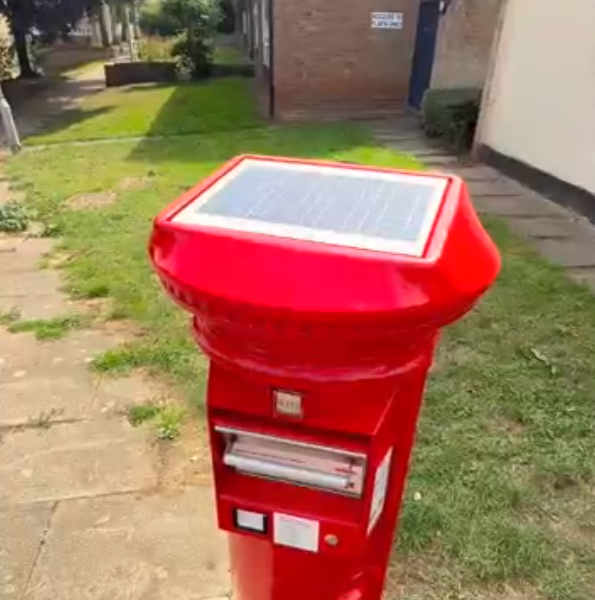
A barcode scanner, powered by solar energy, opens a drawer that allows parcels larger than a standard letter to be inserted
A solar panel, mounted due south on the box, captures maximum sunlight to power the drawer and scanner
A separate slot handles traditional letter deliveries
This upgrade turns the postbox into a small-scale piece of clean energy infrastructure, relying entirely on solar power to function, rather than drawing electricity from the grid.
“We are all sending and returning more parcels than ever before,” says Jack Clarkson, Managing Director of Out of Home and Commercial Excellence at Royal Mail.

Jack Clarkson, Managing Director of Out of Home and Commercial Excellence at Royal Mail
“This trend will only continue as online shopping shows no signs of slowing, particularly with the boom of second-hand marketplaces.”
“There are 115,000 postboxes in the UK located within half a mile of 98% of addresses, making them by far the most convenient network of parcel drop-off points in the UK.
“Our message is clear, if you have a Royal Mail label on your parcel and it fits, put it in a postbox and we’ll do the rest.”
Clean power, lower emissions and energy independence
The technology behind the solar postbox builds on broader trends in renewable energy.
The International Energy Agency (IEA) projects that solar photovoltaic (PV) technology will become the world’s largest source of renewable power by 2029.
Its modular nature allows it to scale, from major grid-connected solar farms to small, standalone units like those now embedded in Royal Mail’s postboxes.
This means Royal Mail’s solar postboxes run entirely on clean electricity and stay off-grid.
According to the World Economic Forum, solar remains both easy to install and cost-effective compared to fossil fuel-based systems.

Matt Gower, Head of ESG at Royal Mail
Matt Gower, Head of ESG at Royal Mail, says: “We’ve put a huge effort into the design and delivery of our environment strategy so that we continue to be the UK’s greenest parcel operator.”
This localised solar power model adds up, especially when multiplied by thousands of postboxes.
These micro-energy units support Royal Mail’s broader push to decentralise its emissions footprint and power infrastructure with renewables.
A delivery network moving towards net zero
The postbox programme is only one part of Royal Mail’s wider transition. In its 2024–25 ESG Report, the firm sets out its climate progress and targets.
The company cuts its greenhouse gas (GHG) emissions by 25% and now operates 7,000 electric vans, 31% of its fleet produces zero tailpipe emissions.
Alongside this, the delivery group shifts part of its heavy vehicle fuel mix to biofuels, saving an estimated 44,000 tonnes of CO? equivalent emissions.
Across its buildings and facilities, Royal Mail now uses 100% renewable electricity. Sites are also adopting energy-saving upgrades including LED lighting and water efficiency systems.
“I’m proud to share our sustainability progress for the year which has once again exceeded our expectations,” says Alistair Cochrane, CEO of Royal Mail.

Alistair Cochrane, CEO of Royal Mail
“Three years ago, we embarked on our Steps to Zero journey to strengthen our position as the UK’s greenest delivery company for parcels and letters and achieve net zero by 2040.
“Since then, we’ve consistently delivered on our targets.”
As solar continues to outperform on cost and scalability, these postboxes mark a shift in what local clean energy infrastructure can look like.
Whether powering off-grid devices or cutting last-mile delivery emissions, solar energy now plays a visible and measurable role in reshaping how everyday services operate.