



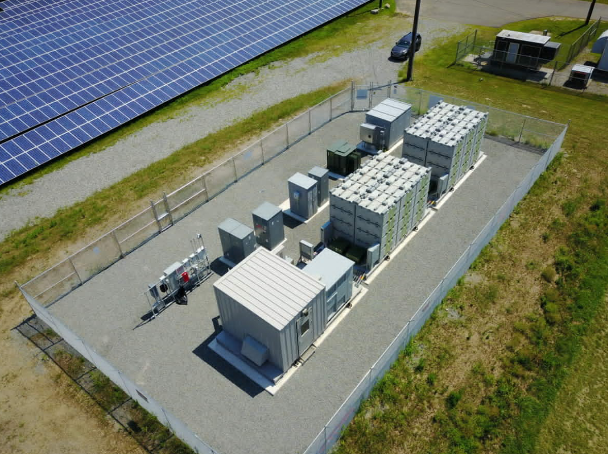
Solar-plus-storage has 99.8% of the capacity value of a theoretical “perfect generator” in California’s CAISO grid region.
That’s the finding of a study commissioned by California’s three major utilities, based on a 500-MW solar farm paired with 500 MW of 4-hour storage, with a 500-MW interconnection.
A similar result emerged from a study of stand-alone storage in the PJM grid region, which found that 4 GW of 4-hour storage could provide capacity of “equivalent reliability value” to that supplied by conventional power plants in PJM.
Both the CAISO and PJM studies were conducted by Astrapé Consulting.
The California study found solar-plus-storage capacity values in the CAISO region would gradually decline to 93.2% by 2030, as storage capacity in the region grows from 1.1 GW to 3.4 GW, based on the utilities’ resource plans.
Added storage reduces the capacity value of solar-plus-storage because as storage lowers the peak load, it broadens the duration of the peak period beyond four hours.
Solar-plus-storage capacity values for Arizona and New Mexico were also calculated, starting at 99% in both states in 2022 and declining to 90.5% in both states by 2030.
Astrapé used an elegant methodology to find that CAISO’s load peak could increase by 998 MW for each 1,000 MW of solar-plus-storage added, with no change in reliability.
Astrapé first adjusted a model of the CAISO region so the “loss of load expectation,” a measure of reliability, equaled 0.1. Astrapé then added the solar plus storage resource to its model, and increased the load peak uniformly across all hours until the reliability returned to 0.1 LOLE. The capacity value is the ratio of the load peak increase in MW, to the amount of hybrid solar-plus-storage added in MW.
California measures capacity value through the metric “effective load carrying capability,” which compares a resource to a theoretical “perfect generator.”
The California Public Utilities Commission ordered the three California utilities to conduct the study.
Capacity values for solar paired with 1-hour and 2-hour storage are expected to be presented in a follow-up report by year-end.
The Astrapé study was conducted by Kevin Carden, Alex Dombrowsky and Chase Winkler.
Solar-plus-storage has a 99.8% capacity value in California
“The energy from solar can consistently charge a 4-hour storage device having the same installed capacity” prior to the hours of peak demand, says a new study. In Arizona and New Mexico the capacity value is 99%.
Source:PV magazine

Via WILLIAM DRISCOLL
- Advertisment -