




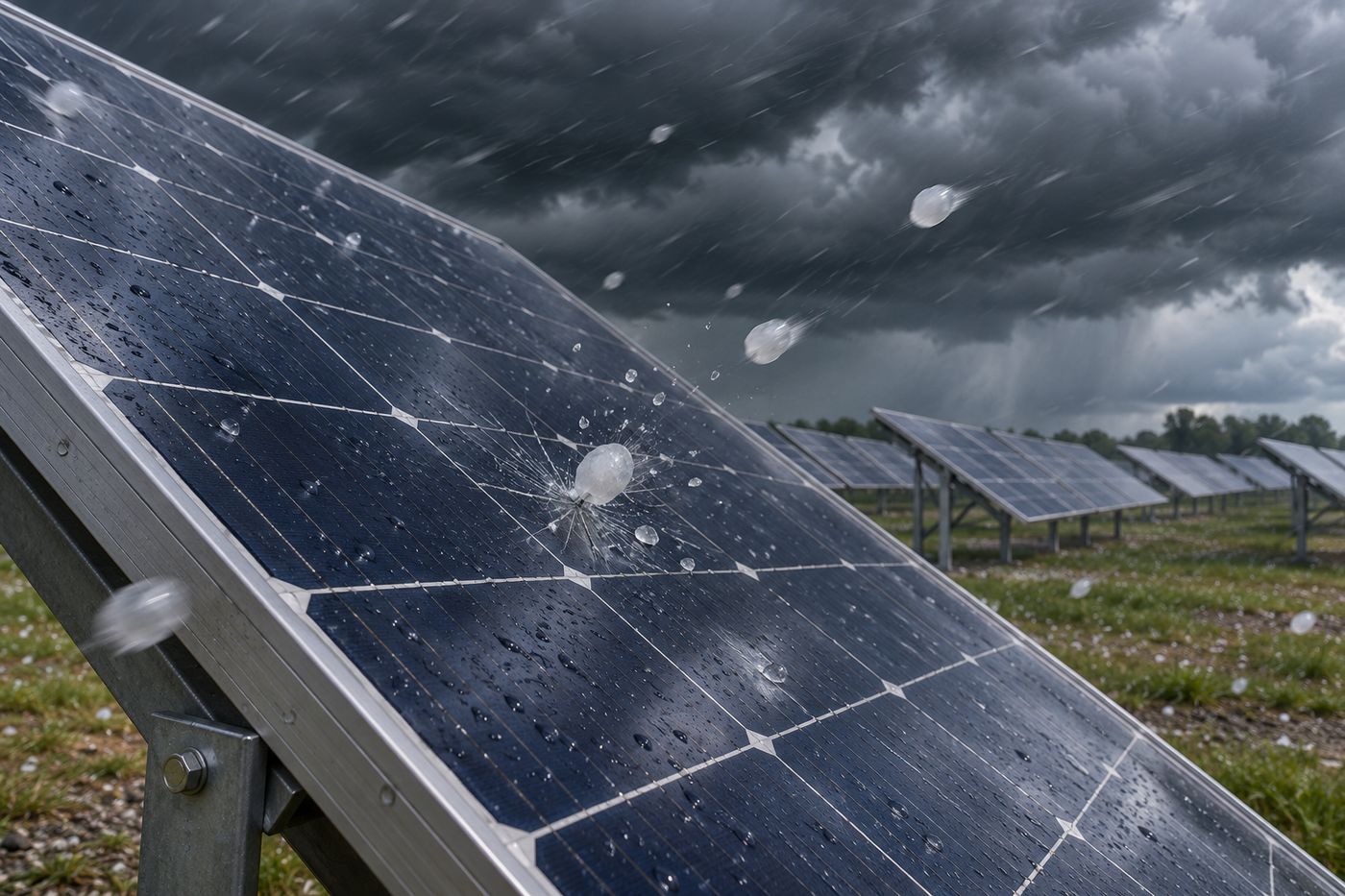
Researchers in Iran have built a computational model that predicts how hailstones strike PV modules under varying wind and tilt conditions, concluding that the best tilt angle for hail protection depends on the site rather than any universal rule.
The team, drawn from Shahrood University of Technology, Radsun Energy Pars and Asoo Vision Pardaz, used a 3 MW solar project in Takestan as its case study, drawing on regional weather records from 2004 to 2024. The model simulates spherical hailstones from 1 cm to 10 cm in diameter under wind speeds of 1 m/s to 50 m/s, released from 2,000 m, with trajectories solved via the fourth-order Runge-Kutta method including gravitational and aerodynamic forces.
The site-specific analysis compared tilt angles of 25 and 30 degrees under four wind scenarios, including 22.8 m/s from 350 degrees and 24 m/s from 200, 350 and 360 degrees. A conceptual damage model applied an assumed critical energy threshold of 2 J to classify impacts.
Corresponding author Armin Hasanpour said wind direction has a significant influence that wind speed alone cannot capture, since direction, speed and panel orientation jointly reshape the angle and energy of each impact. For hailstones of 8 cm or larger, assuming a constant drag coefficient introduced deviations of up to about 14% versus Reynolds-number-dependent calculations. The findings, published in Sustainable Energy Technologies and Assessments, could feed hail-risk databases for insurers and tilt guidance for designers.
✦ This article was adapted by AI from public news sources for informational purposes only. It does not constitute investment advice.