




Though perovskite solar cells look to be well on the way to mass production, interest in the technology is still tempered by concerns about the stability of the material and its sensitivity to atmospheric conditions.
Scientists at the United States National Renewable Energy Laboratory (NREL) claim to have overcome one of those worries. By optimizing a cell’s chemical composition, they say they were able to suppress a mechanism known as light-induced phase segregation, which involves compounds in the solar device breaking down under constant exposure to light.
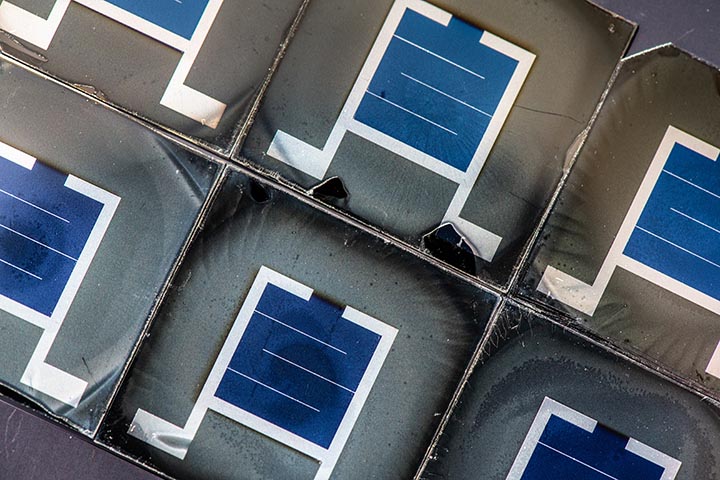
Most perovskite solar cells are fabricated with halides of iodine, bromine or chlorine. The NREL team, however, found a ‘triple perovskite’ incorporating all three materials offered several stability advantages and could also return the high conversion efficiency achieved by other perovskites.
The cells are described in the paper Triple-halide, wide-bandgap perovskites with suppressed phase-segregation for efficient tandems, published in Science. The group said its approach was unique because the researchers incorporated chlorine directly into the lattice at much higher amounts than in previous work. The scientists found the triple perovskite structure offered significant improvements in photocarrier lifetime and suppression of light-induced phase segregation, even at light intensities of up to 100 suns.
Stability
The group fabricated 1 cm² triple perovskite cells which achieved 20.3% efficiency and retained more than 96% of performance after 1,000 hours at maximum power point tracking at 60 degrees Celsius – and more than 97% after 500 hours at 85 degrees Celsius. The cell was also incorporated into a perovskite-silicon tandem device which achieved 27% efficiency.
“Now that we have shown that we are immune to this short-term, reversible phase-segregation, the next step is to continue to develop stable contact layers and architectures to achieve long-term reliability goals, allowing modules to last in the field for 25 years or more,” said Caleb Boyd, the paper’s lead author. “The next step is to further demonstrate accelerated stability testing to really prove what might happen in 10 or 20 years in the field.”
The triple perovskite structure also allowed for further tuning of the bandgap, which could push the efficiency of a perovskite-silicon tandem cell beyond 30% and open up possibilities with other cell structures such as perovskite-CIGS tandem cells, concentrator PV and more.
“The exploration of triple-halide perovskites has identified a promising new region of perovskite single-phase stability,” the group stated in the paper, “and paves the way for another dimension of compositional engineering for perovskites.”