




Scientists at the Lithuania Kaunas University of Technology claim to have improved on the previously announced 23.26% efficiency of a perovskite-based copper indium gallium selenide (CIGS) solar cell they developed with the Helmholtz Zentrum Berlin (HZB).
The researchers claim to have hit 27.5% efficiency with one of the most recently developed monolayers used for the cell. The announcement, however, makes no mention of independent verification of the feat.
Energy materials research center the HZB had achieved 21.6% for the same thin-film CIGS perovskite cell technology, on a slightly smaller surface area in February 2017.
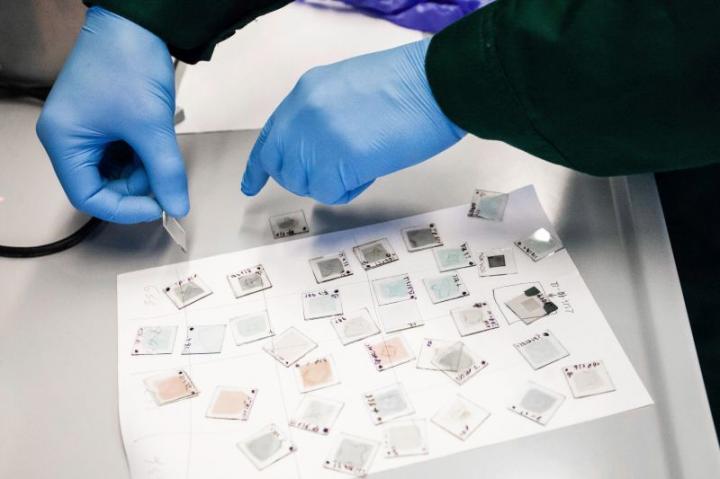
The Lithuanian researchers said the self-assembling material used for the cell is made of molecules based on carbazole head groups with phosphonic acid anchoring groups, and consists of 1-2nm of self-assembled monolayers deposited on the surface of the perovskite by dipping it into a diluted solution.
Cheap and scalable
“Developed monolayers can be called a perfect hole-transporting material as they are cheap, are formed by a scalable technique and are forming very good contact with perovskite materials,” the research team noted.
The scientists said the license to produce the material has been purchased by an unnamed Japanese company and they expect the two materials, dubbed 2PACz and MeO-2PACz, will soon be commercially available.
The world’s largest CIGS module manufacturer is Japanese company Solar Frontier, which is now a unit of oil refiner Idemitsu Kosan. Last January, the Japanese manufacturer said it had set a new record for thin film solar cell efficiency of 23.35% – representing a 0.4% improvement on its previous record of 22.9%, set in late 2017.