




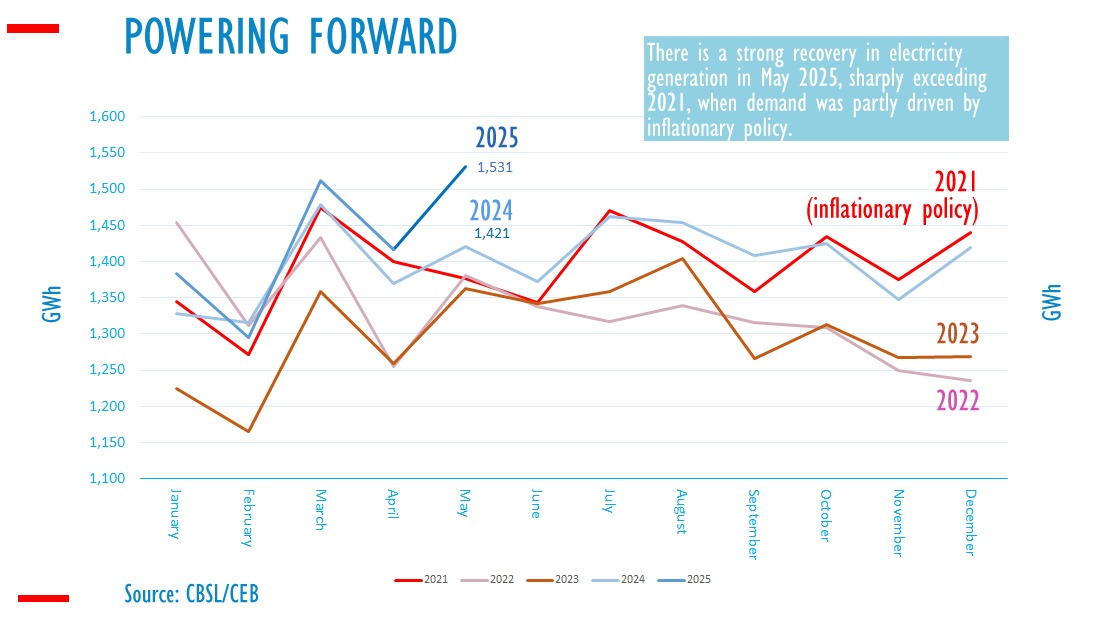
Sri Lanka’s electricity generation has surged 7.7 percent in May 2025 to 1,531 GigaWatt hours, official data show, amid an economic recovery, a price cuts and also an expansion in electric vehicles.
Up to May 2025 electricity generation was up 3.7 percent to 7,167 GigaWatt hours.
Electricity generation is a clear proxy of underlying economic activity.
After February 2025 Sri Lanka has also started to import electric vehicles. The impact on electric vehicles on demand is not yet clear.
Expensive new cars are usually bought by higher income earners who drive more than people owning older cars.
But petrol sales, which is an indicator of private transport was also up 14.8 percent to 128,000 metric tonnes in May.
Sri Lanka’s electricity generation was 16,588 GWh in 2021 shortly before a currency collapse in 2022 which destroyed people’s purchasing power.
However, the economy in 2021 was partly driven by inflationary policy of macroeconomists as money printed money to suppress rates, running down foreign reserves.
Economic activity contracted in 2022 with electricity generation falling to 15,942 GWh. In 2023 electricity generation fell to 15,565 GWh
The economy has started to recovery amid stability provided by the central bank with deflationary policy except in the last quarter of 2024.
In 2025, electricity generation grew to 16,802 GWh, exceeding the 2021 figure of 16,588 GWh.
In December 2024, electricity generation grew by a double digit 11.8 percent, partly helped by tourism, but there was also some inflationary policy in the last quarter of 2024.
The central bank has continued mildly deflationary policy in 2025, but concerns have been raised about the last rate cut and also inflationary swaps with domestic banks.
Sri Lanka electricity generation surge in May amid economic recovery

- Advertisment -