




Low- and moderate-income (LMI) households are less likely to install rooftop solar photovoltaics, and policymakers, stakeholders, and community leaders are calling for a more equitable adoption of these technologies.
Research from the Lawrence Berkeley National Laboratory and Clean Kilowatts suggest improved marketing strategies could help.
Researchers to date have focused on demand-side explanations for adoption inequity. Those factors include cash constraints, lower homeownership rates, building structural issues, and language barriers. Likewise, LMI policies largely have been designed to address demand-side barriers, such as adoption subsidies and carve-outs in community solar programs.
The report argued that supply-side factors may pose significant barriers, as well.
For one thing, the industry often selects to market to high-income customers. The report found a significantly lower number of project quotes are shown to LMI customers. Fewer quotes mean those customers have fewer opportunities to gather information and make an informed buying decision. Higher price quotes also can occur as there may be less competition among installers in LMI markets.
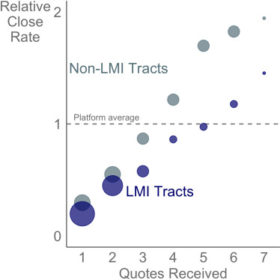
LMI customers receive fewer quotes.
Image: ScienceDirect
The report noted one study of solar industry quotes and contracts that found that customers who received fewer than four quotes were about three times less likely to adopt solar than those who saw more.
The report suggested that the supply side issues in solar can be addressed in a way similar to inequity in food access. It said that large grocery stores stocked with healthy foods often are located in affluent areas, while LMI areas often host low-quality food stores. Through a series of state and local interventions, policymakers responded by providing supply side incentives to induce health-oriented grocers to open in LMI areas.
The researchers offered three policy solutions for improving LMI solar access:
1) Providing subsidies or non-financial incentives to solar installers who will site their headquarters in LMI communities.
2) Offering incentives for submitted quotes in LMI communities, rather than installed systems. The research found that increased numbers of quotes drive higher adoption, despite installers having a bias that LMI customers install solar less frequently.
3) Funding programs to train installers to understand the unique needs of LMI customers.