




Thanks to Hawaii’s smart inverter settings, most customers can “instantly interconnect” new solar despite high levels of solar already on distribution circuits. That’s according to Steven Rymsha, policy director for grid solutions at Sunrun.
He said that other states considering smart inverters “need to understand what Hawaii has achieved” through smart inverter functions, in terms of increased hosting capacity, deferral of new infrastructure, and consumer protection.
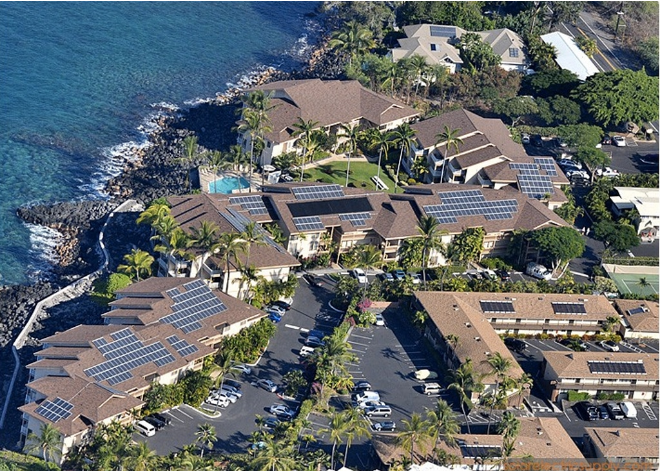
“People still don’t believe the amount of saturation” of distributed solar in Hawaii, Rymsha said in an interview. He said that distributed solar represents about 18% of generation in Hawaiian Electric’s service area, or around half of the utility’s renewable generation.
Hawaii has achieved this with the help of the smart inverter setting known as volt-var for all new distributed solar, with the option for customers also to activate the volt-watt setting if the utility would otherwise require a study and circuit upgrades. Each setting works to keep voltage stable on distribution circuits as more solar is added.
The Hawaii Solar Energy Association, utility Hawaiian Electric, and others have proposed blanket activation of volt-watt alongside volt-var, combined with consumer protection measures for rare cases where volt-watt causes excessive curtailment. California already uses both volt-var and volt-watt.
Evaluations underway
Twelve states besides Hawaii and California are evaluating smart inverter standards: Idaho, Arizona, New Mexico, Texas, Minnesota, Illinois, Michigan, Kentucky, North Carolina, Maryland, New York, and Massachusetts, plus Washington, D.C.
Following a 10-year career with Hawaii utilities and now working on state policy for Sunrun, Rymsha said that when a state begins discussing smart inverter settings, utilities say “‘We can’t have one common setting like California and Hawaii, that’s not going to work for us.’ They seem to be stuck in this mode of analyzing.” In one state, he said, the smart inverter discussion has been going on for two years “and we have nothing to show for it.”
Citing Hawaiian Electric’s interconnection ease, infrastructure deferral, and consumer protection, Rymsha said, “Once you have that you’ve really solved the issue. The utility is in a proactive stance, you have happy customers, you have happy regulators, everyone wins, and Hawaiian Electric’s not complaining about all these problems,” because the smart inverter functions are “fixing” the voltage issue.
Wasted infrastructure
Rymsha said he is concerned about “how much wasted infrastructure” will be built in other states as a result of delays in choosing smart inverter settings. He said he empathized with utility staff with whom he interacts, and said that “everyone’s scrambling for time, everyone’s delayed.” Even so, “they’re imposing requirements on interconnection that just make the processes clunkier, harder, longer.”
Rymsha said that a decade ago, when he worked at Kauai island’s utility, “we were trying to figure out” how smart inverter functions were going to work. Six years ago, when he left Hawaiian Electric, “interconnection was really challenging, as we were just policing thresholds.” Now, he says smart inverters are “working fabulously, they’re working incredibly.”
Solar association leaders in Hawaii and California recently echoed that sentiment, saying that with smart inverters being required for new distributed solar, they no longer hear of limits to new distributed solar due to voltage issues.
The consultancy GridLab has produced a brief report on regulating voltage using smart inverter settings, targeted at a general audience. And the National Renewable Energy Laboratory has published a longer document, with more technical detail, on the same topic.