





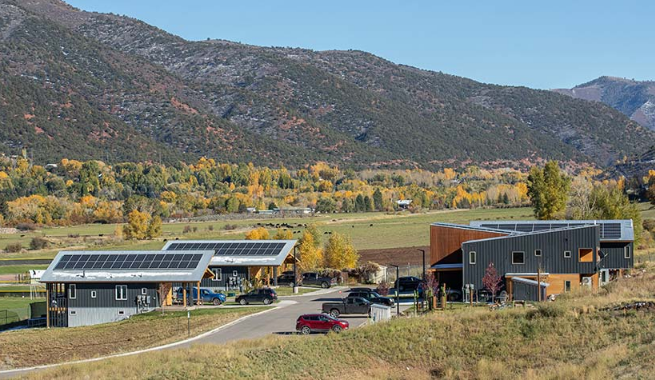
The National Renewable Energy Laboratory (NREL) will now test the use of artificial intelligence (AI) in home energy management systems. The Basalt Vista community in mountainous Colorado will play host to the “foresee” AI system, which will control the internet-of-things (IoT) connected devices, which include rooftop solar, heating, electric vehicle charging stations, air conditioning, and more.
Photovoltaic generation, battery storage, and grid operations will be controlled by the Amazon Web Services-backed software, and residents will be able to set preferences related to energy savings, comfort, and carbon dioxide emissions reduction. A cloud-based aggregator will also coordinate among multiple units to manage resources across the community.
Energy storage and management aggregation has been studied to have numerous cost-saving effects. A trial run by the University of Otago, New Zealand, and local installer Aurora Energy found that aggregation of smart storage led to two significant improvements. It found a reduction in per-house battery requirements by 50% for load-smoothing, and by 90% for peak shaving operations.
While AI has been used in energy management models for many years, it is a first to have it operable in multiple linked homes, said NREL. Lead researcher Xin Jin said, “Although we’ve tried to create models that are as close as possible to these homes, there are some elements, such as human behavior and occupancy, that are challenging to model. We’re excited to see how these uncertainties affect actual performance.”
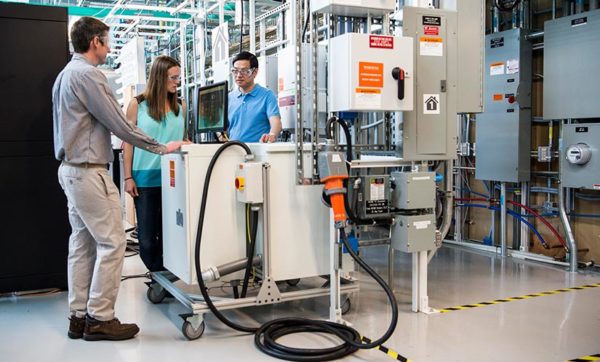 NREL researchers Scott Carmichael, Bethany Sparn, and Xin Jin.
Image: NREL
Numerous partnerships made this field test possible, including co-funding from the U.S. Department of Energy Solar Energy Technologies and Building Technologies offices, plus local partnerships with electric cooperative Holy Cross Energy and Habitat for Humanity.
Copper and Conservation Labs provided advanced sensor technologies that enable some of the key functionalities of the AI energy management system. The wireless energy monitors provide high-resolution energy consumption data, plus voltage measurements from each home and service transformer in real time.
The system was under development for years in NREL’s lab a few hours down the road in Golden, Colorado. Research engineer Bethany Sparn said, “The first year of the project was used to develop control algorithms based on simulated buildings. In the second year, we took those models into the lab with real equipment to identify integration challenges or hardware compatibility issues—and we worked out those kinks in the lab rather than in peoples’ homes.”
In the initial installation phase, the researchers will hold a meeting with homeowners to choose preferences in heating and cooling, as well as ranked priorities in saving energy, reducing energy bills, or comfort. Once implemented, the energy management system will operate the hardware accordingly. If carbon footprint reduction is the top priority, the system will reduce the home’s energy use when the grid is operating with more carbon-intensive energy like coal.
The researchers said the goal is that the equipment will work behind-the-scenes, and that homeowners will notice no change other than a lowered electricity bill.