






As the U.S. electric grid reinvents itself, a collaboration between the U.S. Department of Energy (DOE) and several top national laboratories is underway to provide research insights that will inform grid markets, investments, and planning.
A three-year project, organized as part of the Grid Modernization Initiative, the research aims to provide foundational technical assistance to the seven U.S. independent system operators (ISOs) and regional transmission organizations (RTOs) that regulate about 70% of electricity sales in the country.
The first of a series of reports, released this May, identified gaps and research priorities related to evolving competitive wholesale energy markets. The paper lays out a broad research agenda for market designs that are of high priority for the next 2-10 years.
The researchers worked closely with ISO and RTO representatives to understand current market design challenges and opportunities to develop a ranked priority list of relevant topic areas. The topics of highest priority were reliability services and operational flexibility, followed by emerging technologies.
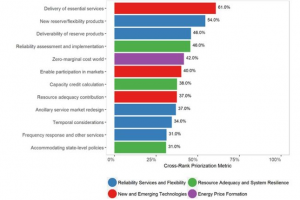
The study team is currently executing three parallel tasks to address the ISO/RTO-prioritized tasks of flexibility and operational reliability, resource adequacy, and market mechanisms that support resource investments.
According to the paper, the rapid growth of emerging technologies, including battery storage and hybrid resources, offshore wind, distributed energy resources, and demand-side flexibility creates a new set of characteristics different from conventional generation modes, and the ability of the current electricity market structures to ensure both long-term and operational reliability is unclear.
Essential reliability services (ERS) requirements often shift under new technologies, but these technologies also have often under-utilized capabilities to provide ERS themselves. Market rule changes could enable these technologies to participate in providing the full range of ERS. Also, the development of new methods to calculate the contribution of these emerging technologies will be instrumental in the long-term planning process.
The ISO/RTO group also shared the view that system resources must be appropriately incentivized to provide grid services and operational flexibility needed to maintain system reliability in an economically efficient manner. Specifically, they advocate for the development of market products for new reliability services, deliverability of capacity products, adjustments to existing ERS, and potential implementation of multi-day markets for energy-limited resources.
In addition, a key challenge over longer horizons is providing incentives that ensure revenue sufficiency for resources needed to guarantee long-term reliability, while also providing efficient price signals for market exit. The report calls for well-designed scarcity and shortage pricing, especially in systems with high penetration of zero-marginal-cost resources.
The report is the first in a series of collaborations with U.S. Department of Energy (DOE), the National Renewable Energy Laboratory (NREL), Argonne National Laboratory, Electric Power Research Institute, Lawrence Berkeley National Laboratory, and Johns Hopkins University.