





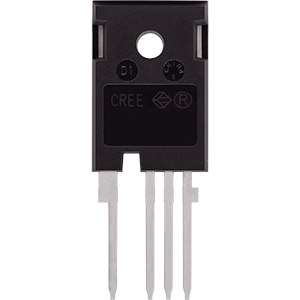
CREE, a U.S. silicon carbide (SiC) technology developer, has unveiled its new Wolfspeed 605 V SiC metal-oxide-semiconductor field-effect transistor (MOSFET). It claims the new transistor is ideal for a broad range of industrial applications, including silicon carbide inverters, on-board electric vehicle chargers, fast DC charging stations, and data center servers.
MOSFETs are semiconductor devices that are widely used as transistors. They are mostly based on silicon and are commonly used in all kinds of electronic devices for switching and to amplify electronic signals. CREE claims that switching losses with its new 15 mΩ and 60 mΩ device are 20% lower than with competing silicon carbide MOSFETs.
“String inverters are the main application – typically 10 kW or greater in power handling capability,” CREE CTO John Palmour told pv magazine. “Our 650 V silicon carbide MOSFETs require fewer components, a smaller footprint and as a result, lighter weight.”
The company’s new MOSFET reduces switching losses by up to 75%, resulting in higher efficiencies at higher frequencies, Palmour said. “Additionally, there is up to 70% greater power density and vastly improved thermal performance, all at a lower system cost,” he added.
The lower switching losses – combined with what the company claims is a 50% decrease in conduction losses – offer the potential for 300% growth in power density. The manufacturer also claims that the new design takes full advantage of silicon carbide’s fast switching speeds, superior thermal properties, and low on-state resistance over the entire operating temperature range, to offer a potential 10% to 15% reduction in total costs.
“The passive components used with our power devices become smaller, the amount of metal and number of fans needed for cooling is reduced, and the actual enclosure for the inverter itself becomes smaller,” Palmour said. “All of these combined gives you better performance at a lower system cost.”
CREE manufactures the new MOSFETs at its production facilities in North Carolina.
SiC power MOSFET technologies have improved considerably over the last few years and now offer greater efficiency, power density, and reliability at lower costs. Silicon-carbide-based inverters, however, are still far from reaching commercial maturity. Although such devices offer higher power density at lower costs than traditional inverters – with less need for cooling – commercial production remains unviable due to defects at the interface between the silicon carbide and the insulating silicon dioxide material.