




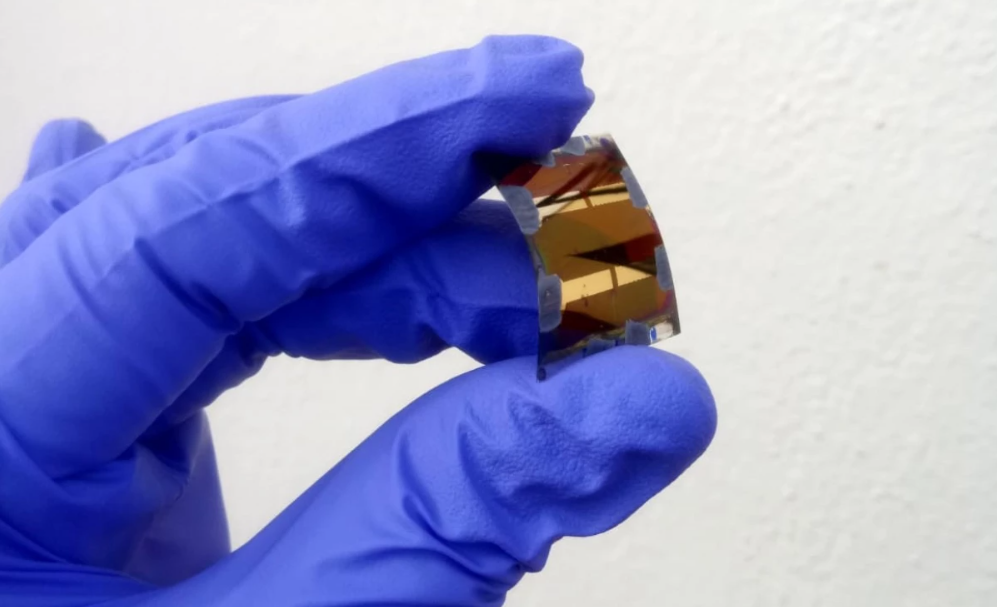
It might sound counterintuitive to put solar cells indoors, but there’s still plenty of light energy inside that’s largely going to waste. Now, a team of engineers is claiming to have created flexible perovskite solar cells with the highest efficiency of any indoor flexible solar cells.
In homes, stores, offices and other buildings, interior lighting generally shines at between 100 and 500 lux. It’s obviously a far cry short of sunlight, which typically bathes the world in about 110,000 lux, but it’s still enough to work with.
The new design comes from researchers at Tor Vergata University of Rome, Universidad Surcolombiana, and the Fraunhofer Institute, and involves depositing perovskite solar cells onto glass substrates that are ultra-thin, flexible and coated in indium tin oxide (ITO). The end result is photovoltaic cells that are bendable, strong, and can harvest light at indoor brightnesses.
In tests under LED illumination, the cells were found to have efficiencies of 20.6 percent under 200 lux, and 22.6 percent under 400 lux. The team says that this makes them the highest reported efficiencies of any flexible and curvable indoor photovoltaic technology.

And that does seem to hold true, if not just because of the several qualifiers included in the claim. Previous indoor photovoltaic cells we’ve seen have had efficiencies as low as 10 percent, while those that ranked higher – up to 26.1 percent – only did so under 1,000 lux.
Power densities on the new designs are relatively low, but that’s to be expected with indoor cells. In this case, under 200 lux the density reaches 16.7 microWatts per cm2, and 400 lux bumps it up to 35 microWatts. That means these cells won’t be running anything too power-hungry, but they might be useful for small sensors or Internet of Things devices.
The researchers also say that the manufacturing method is easy to scale up, so these flexible solar cells should be relatively cheap to make in bulk.