





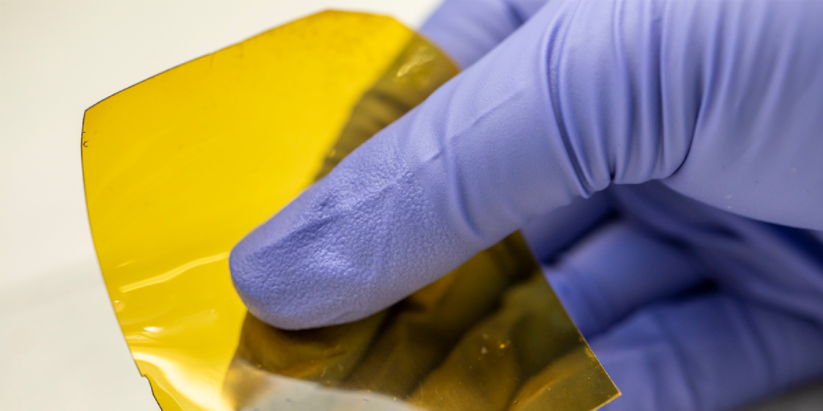
Researchers at the United States Department of Energy’s Lawrence Berkeley National Laboratory have developed a membrane for energy storage systems they claim could lead to cheaper large scale flow batteries and accelerate the grid integration of renewables.
Presented in the paper Design Rules for Membranes from Polymers of Intrinsic Microporosity for Crossover-free Aqueous Electrochemical Devices, published in Joule, the membrane is described as an alternative to costly fluorinated polymer materials the researchers say contribute 15-20% of flow battery costs.
The new material, which its developers say performs better as well as being cheaper than alternatives, is made of an ion-selective, aqueous-compatible polymer with intrinsic microporosity known as AquaPIM and is said to have tunable thickness and high conductivity in aqueous electrolytes.
Amidoxime
The membrane was modified with the chemical amidoxime, which is widely used in the pharmaceutical industry and as a polymer or chelating resin. Chelants are chemical compounds which react with metal ions to form stable, water-soluble complexes. The use of amidoxime with the material, the scientists claimed, allowed ions to travel quickly between the anode and cathode.
“These design rules are likely to apply to other AquaPIM variants and microporous polymer analogs in both static and flow systems, for the breadth of aqueous cell chemistries currently under investigation for redox-flow batteries, hybrid redox-flow batteries, redox-targeting batteries and solar flow batteries,” the researchers wrote. “Our work should greatly accelerate the identification of membranes for long-lasting, megawatt scale redox-flow and other low-cost grid batteries, which are required to last 10-20 years.”
Flow batteries
In a flow battery, the electricity is stored in a liquid rather than on electrode surfaces. The electrodes do not change during charging and discharging reactions as the electrochemical reaction takes place in the liquid. Unlike the lithium-ion batteries they compete with, flow batteries have electrolytes which do not degrade.
The most promising applications for flow batteries are megawatt-sized installations in power networks. Such devices could be particularly beneficial for peak shaving and grid services or help small to medium-sized factories manage power demand. Flow batteries, however, require pumps and aqueous electrolytes which offer comparatively low energy density. They also reduce the efficiency of the energy conversion process, are unwieldy for most forms of transport and require more floorspace than alternative battery storage systems.