





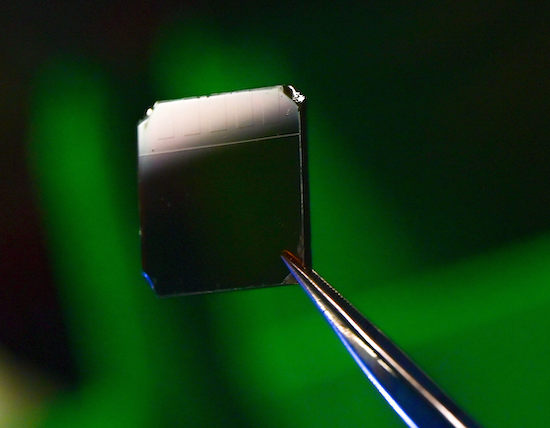
A U.S.-French research group has developed a 2D perovskite solar cell with enhanced electron flow and a threefold increase in the electron conduction of the perovskite material.
Perovskite cells built with 2D hybrid materials are generally known for being more stable than conventional, 3D devices, due to the protection provided by the organic ligands, and exhibit large exciton binding energies. “2D perovskites have tremendous stability but are not efficient enough to put on a roof,” the scientists explained. “The big issue has been to make them efficient without compromising the stability.”
The researchers designed the new cell after they discovered that, when the sunlight hits a 2D perovskite, it contracts the space between atomic layers in the material. “We find that as you light the material, you kind of squeeze it like a sponge and bring the layers together to enhance the charge transport in that direction,” they further explained.
Under standard illumination conditions, the 2D perovskite material used for the cell contracted by 0.4% along its length and about 1% top to bottom. “It doesn’t sound like a lot, but this 1% contraction in the lattice spacing induces a large enhancement of electron flow,” said research co-lead author Wenbin Li. The perovskite material’s lattice also showed lower degradation rates compared to 3D materials when it was heated to 80 degrees Celsius.
The solar cell was built with a layer of organic cations between the iodide on top, and lead on the bottom enhanced interactions between the layers and achieved a power conversion efficiency of 18.3%. “We’re on a path to get greater than 20% efficiency by engineering the cations and interfaces,” co-lead author Siraj Sidhik said. “It would change everything in the field of perovskites, because then people would begin to use 2D perovskites for 2D perovskite/silicon and 2D/3D perovskite tandems, which could enable efficiencies approaching 30%.”
The cell is presented in the study Light-activated interlayer contraction in two-dimensional perovskites for high-efficiency solar cells, published in nature nanotechnology. The research group comprises scientists from the Rice, Purdue and Northwestern universities, and U.S. Department of Energy national laboratories in Los Alamos, Argonne and Brookhaven and the Institute of Electronics and Digital Technologies (INSA) in Rennes, France.