




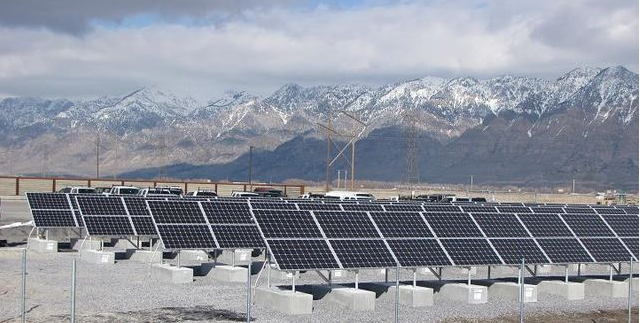
Solar has room to grow, according to researchers at the Atmospheric Sciences Research Center at the University of Albany in New York. They produced a GIS-based interactive map that analyzes where, and how much solar is needed to reach at least 50% of the energy demands for each state.
The map allows users to modify numbers, tweaking the percentage of load needed to be met by solar power, adjusting the locational ground efficiency of PV panels, and modifying land use types with varied suitability for solar deployment.
The researchers reported their findings in a paper published in Solar Energy. They said that oversized/curtailed PV can meet half of U.S. energy demand firmly and affordably, and that the capacity would occupy 0.25% of the total continental U.S. land surface.
The map showed there is more than enough suitable land in every state. A combination of building footprints and rights-of-way for high-voltage power lines together could supply most of the required space.
In order to reach a 50% PV penetration figure, the researchers estimated 3.8 terrawatts of solar would be enough to meet electric, transportation, and building sector demands.
The university’s Senior Atmospheric Scientist Richard Perez and his co-authors arrived at their deployment estimates by contrasting two approaches, analyzing both a “top-down” approach with global land use data, and a “bottom-up” approach that accounted for only land areas open to PV deployment that also would not require a change of function (for example, transmission right-of-way.)
Both approaches suggested that enough room exists not only for a 50% PV penetration, but that every state can accommodate 100% PV. The Washington, D.C. region would be accommodated by solar capacity in neighboring Virginia and Maryland.
Perez said there is a growing misunderstanding that there is not enough space to accommodate solar PV, or that arrays will destroy farmland and pollute the water. He said the map provides realistic numbers to refute these arguments. PV penetration, usable land types, and ground efficiency are all adjustable, so if users do not agree with the researchers’ specific assumptions, they can be changed and verified.
Perez has earlier argued for a strategy that he calls “implicit storage” in which renewable capacity is oversized, and energy curtailment is used. This is an alternative way to bridge the gap between intermittent renewable production and customer demand, something that rising energy storage deployment seeks to address.