




German start-up Sunfarming Group has developed two new agrivoltaic systems in cooperation with Germany’s Forschungszentrum Jülich and the Fraunhofer Institute for Solar Energy Systems ISE.
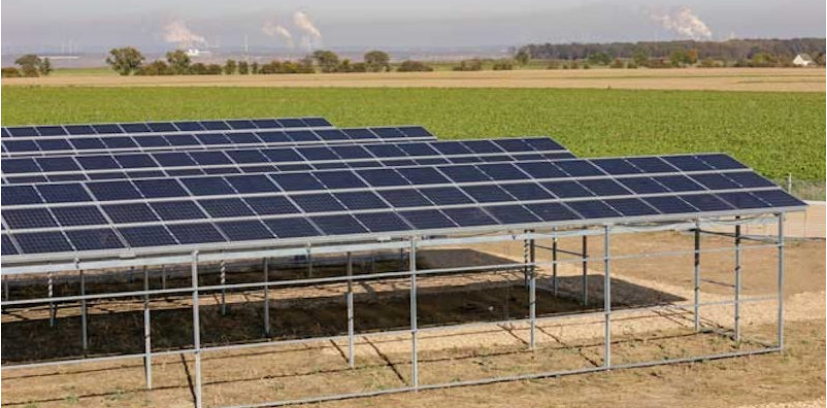
One of the two arrays is an evolution of the company’s Sunfarming Food & Energy system type, in which glass-glass modules are placed at a height of 2.5 meters and the mounting system is designed with a large post spacing to enable the use of big agricultural machines.
The second type of installation, the Sunfarming Food & Energy Tracking System, was developed with custom-made solar modules equipped with trackers and a total height of over 6 meters and a headroom of 4 meters. This system is used to research various shading scenarios for the plants as well as more efficient rainwater management in order to make plant cultivation more climate-resilient.
The demonstration plants in Morschenich-Alt Ende, in the North Rhine-Westphalia region, are expected to be completed in February. Their construction began at the end of the year after nine months of development. Comprehensive research work on plant cultivation in agri-photovoltaic systems is set to begin when the plants are completed. The system is expected to produce some 300,000 kWh of solar power annually. The solar power generated will also be used to supply the research site.
“We have been working successfully with the research center Jülich for many years, especially in the field of agrivoltaic systems,” explained David Morr, head of Food & Energy Projects at Sunfarming. The company operates its own research and innovation park in Rathenow, Brandenburg. The knowledge gained there was incorporated into the new developments.
“Based on the requirements of our clients, we were able to build two Food & Energy plant types for Morschenich-Alt, which are suitable for multiple use of space, with regard to the production of solar energy and the cultivation options for berries, medicinal, oil and fiber plants demonstrate new solutions under changing climatic conditions,” he continued.
Sunfarming is also currently realizing an “eco-solar plant” on a former gravel pit about 20 kilometers away from the demonstration plants. According to the company, this is the first photovoltaic system of this type in the Rhineland. Completion is scheduled for April. In addition, further photovoltaic systems are being planned in the district of Heinsberg.