




Breaking research published in the Journal of the American Chemical Society demonstrated the efficacy of what has been hailed a “wonder material”: phosphorene nanoribbons (PNR).
The material, first produced in 2019, is comprised of ultra-thin “2D” layers that are one atom thick. Many theoretical use cases have been considered for the material, including enhancing batteries, biomedical sensors, and quantum computing.
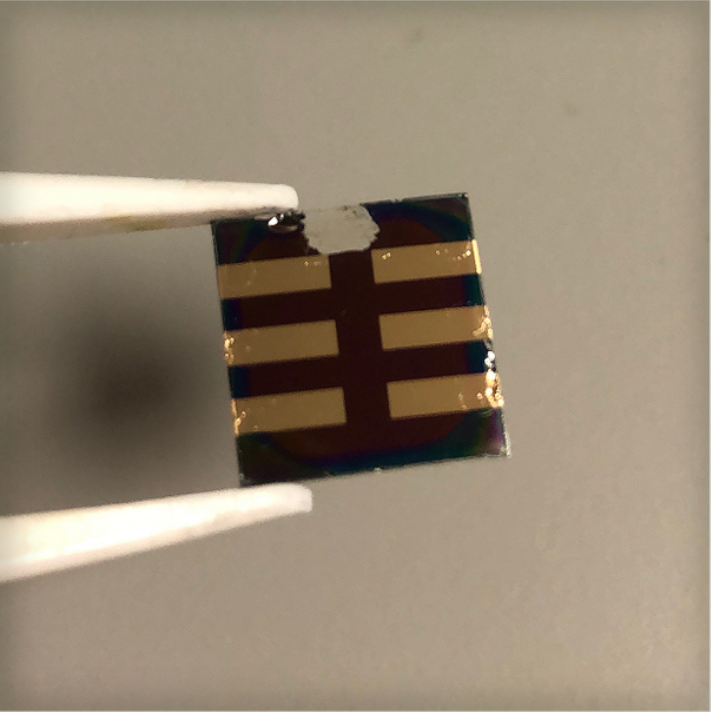
Now, a research team from the Imperial College of London and University College London have brought the theoretical to the actual, demonstrating the photovoltaic-boosting effect PNR brings to solar cells. When applied in tandem with a perovskite solar cell, PNR-boosted cells achieved an efficiency above 21%, putting them on par with traditional silicon cell output levels.
Perovskites are hailed for being earth-abundant, and highly alterable by scientists. Improvements in efficiency and stability are being evaluated worldwide in test laboratories to find a possible counterpart to silicon solar cells, which are tied to some supply-chain constraints and labor concerns.
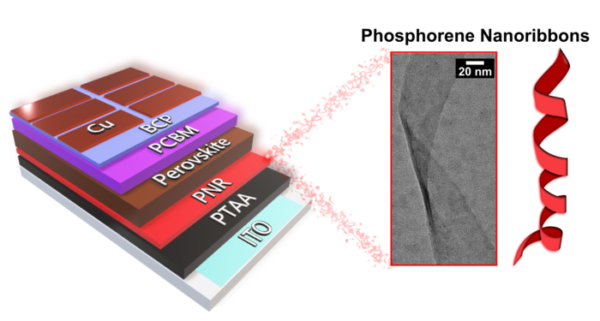
Image: T.J. Macdonald and T. Webb
PNRs directly aided the perovskite cells in “hole mobility.” In photovoltaics, the “hole” represents the partner of electrons in electric transport, so increasing hole mobility improves the speed and strength of the current between the layers of the device, improving overall efficiency.
The research team said that in addition to improving perovskite cells, the experimental validation of PNRs will also help create design rules for optoelectronics, which are devices that emit or detect light. Further experimentation will continue to modify the surface of the PNR, possibly improving the unique electronic properties of the material, said the team.