




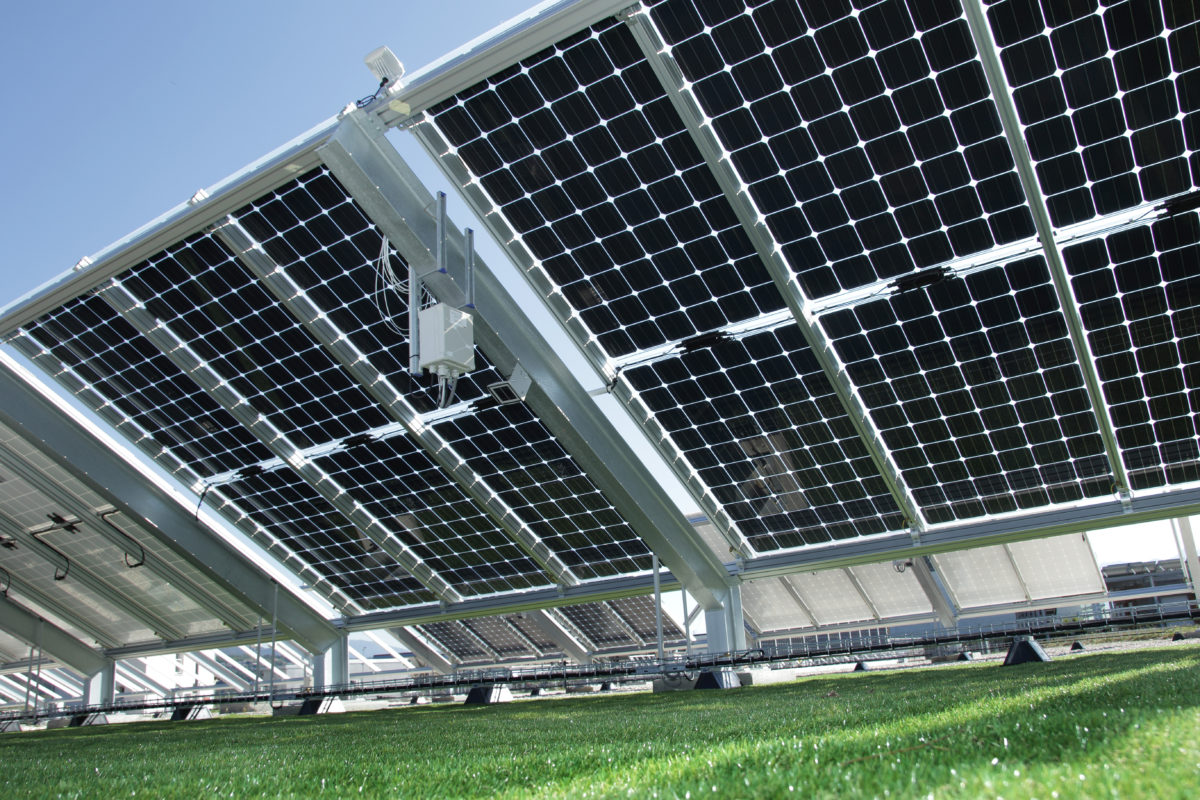
How to measure power output from bifacial PV panels is a recurrent question for the solar industry.
The Institut National de l’Énergie Solaire (Ines) division of France’s national low-carbon energy Commissariat à l’énergie atomique (CEA) has suggested: “The characterization of a bifacial module cannot be limited to the standard measurement of the performance of its front face. The rear face must also be measured to define the bifaciality and to estimate the effective power of the module according to different albedos.”
And the CEA knows what it is talking about, too, according to the results of a two-year exercise carried out by the Solar Energy Research Institute of Singapore (Seris), which processed the results of tests carried out by 25 global laboratories on eight reference bifacial products, in order to assess the testing methods of the research centers and certification bodies in question.
“CEA-Ines has been able to verify that the reliability of its measurements and methods for characterizing bifacial photovoltaic modules is up to that of internationally recognized certification institutes,” said the organization, following the results of Seris’ ‘round-robin’ exercise. The results, added CEA-Ines, offer “a guarantee of quality and reliability of the results announced by its laboratories!”
Under the Seris program, the bifacial lab testing was carried out on reference panels made by Chinese manufacturers Longi Solar, Jinko Solar, Jinergy and Linyang Photovoltaic and Sino-Canadian company Canadian Solar, in accordance with the IEC TS 60904-1-2 standard.
Other participating laboratories included the U.S. Department of Energy’s National Renewable Energy Laboratory; the EU’s Joint Research Center; German trio Fraunhofer-ISE, TÜV-Rheinland and PI-Berlin; Dutch research institute the TNO; Seris itself; PI-China; Switzerland’s CSEM- EPFL; and Australia’s Csiro.