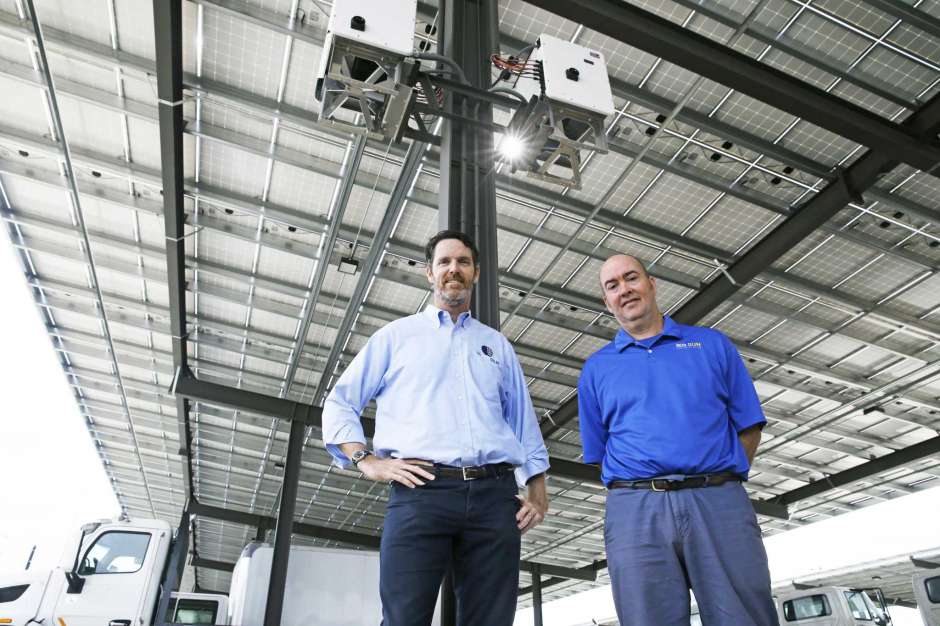
By the end of this year, Big Sun Community Solar plans to have installed solar panels atop 2,000 San Antonio parking spaces at more than a dozen locations.
The 3 megawatts of solar power generated — which could increase to 5 megawatts in coming months — go into CPS Energy’s power grid. The city-owned utility then credits the community solar customers on their bills during the next 25 years.
Participating in the project isn’t cheap.
Lissa Martinez, a retired engineer, and her husband Brian Hughes, a entrepreneur who serves on the Massachusetts Institute of Technology’s board of trustees, paid $23,000 to participate in the community solar program for their home in Castle Hills late last year. They receive a 30 percent federal tax credit, which helped make the expense easier to take.
The upfront costs cover their electrical bill for the next 25 years, which averaged around $100 a month.
“I wanted to put my money where my mouth is,” said Martinez who had served as a member of the SA Climate Ready Advisory Committee, the group that’s monitoring the city initiative to deal with climate change.
Miggins said the residents in the program can’t install their own solar panels for a variety of reasons. Maybe their houses are poorly positioned to collect sunlight or they live in an apartment building.
Big Sun Community Solar builds the solar roof carports at no cost to participating commercial property owners, and charges a monthly fee for each space. In turn, office park tenants pay the owners an extra fee for shaded parking spots.
Big Sun Community Solar built 391 solar car ports at four office complexes managed by San Antonio commercial real estate company Worth & Associates late last year and in early 2020.
“It’s a lot more comfortable getting into your car in the summer when its parked under a shaded space,” said Clint Worth, president of development and brokerage. He said shaded parking is an amenity tenants will pay for in the San Antonio summer heat.
Big Sun is the second community solar progrma offered by CPS Energy. The first offered a similar deal to 250 homeowners in 2016, but the panels were located at a solar farm.
The programs are a small part of CPS Energy’s alternative energy initiative. About 20 percent of the utility’s generation comes comes solar and wind farms, an output that environmentalists have pressed the utility company to expand.
Go Smart Solar employs around a dozen people. Miggins, who has worked in the solar industry for six years, partnered with Jason Pittman, an engineer who serves as the firm’s president.
Miggins said expansion to other cities is critical to growing the company. But he acknowledged that Go Smart’s growth could be slowed by utility companies dealing with coronavirus-related issues.
“I think the virus has put a question mark around the timing of these things, but we are hopeful that will have some announcements later this year,” he said.