




An international research group has built and experimentally evaluated five planar heat-pipe prototypes for active cooling of PV modules, reporting peak surface temperature reductions of roughly 8 C to 32 C depending on configuration and heating conditions.
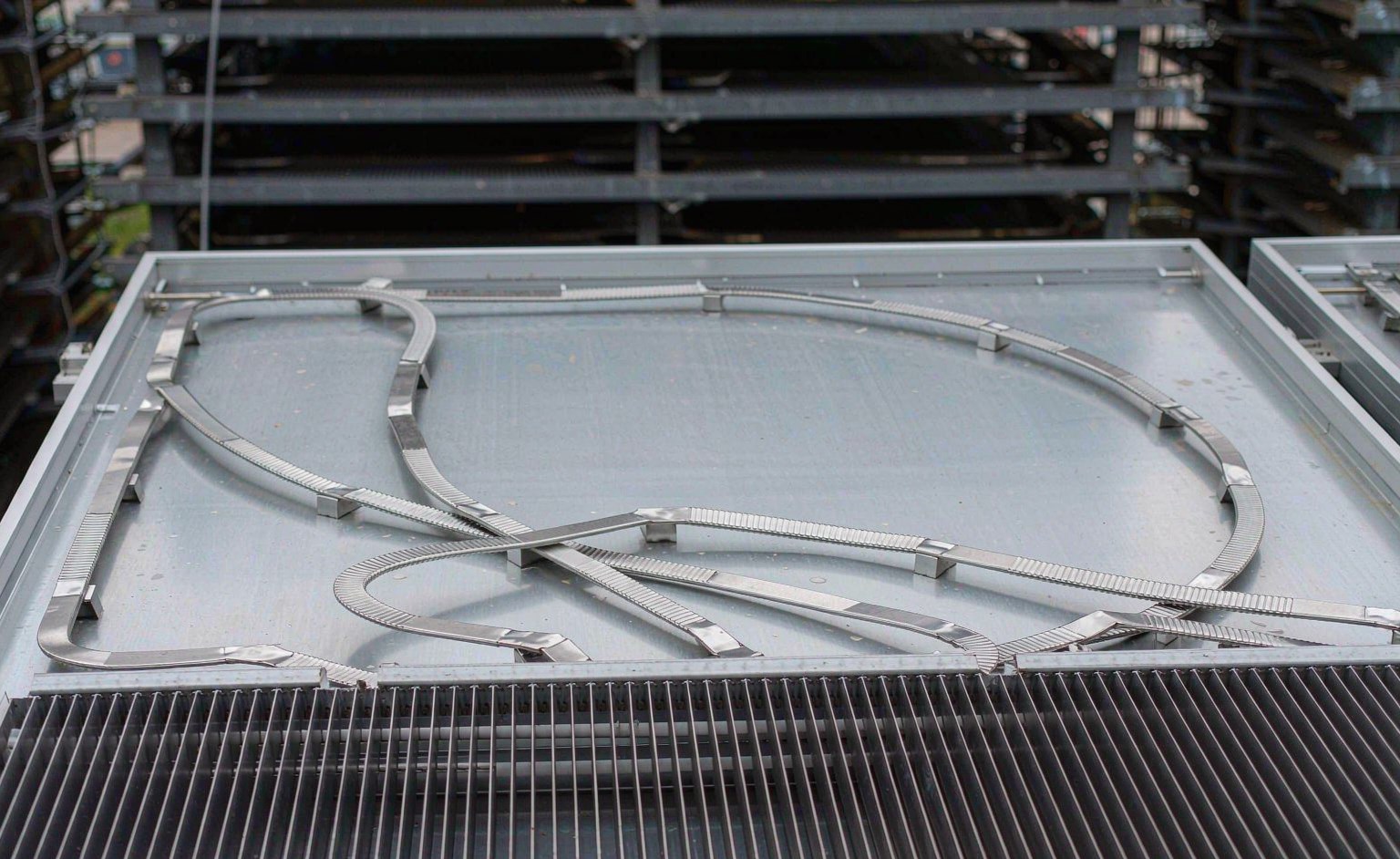
The prototypes measure 1,650 mm x 1,000 mm and consist of stainless-steel plates enclosing cavities about 2 mm high filled with distilled water. Internal mesh, wire inserts and fence-like supports aid liquid return and reinforce the structure. The five designs differ in internal structure, plate thickness and water content, with most holding 0.9 liters of water and one variant halved to 0.45 liters.
An automated rig with 32 heating pads simulated uneven PV heating at 50-100 C. The prototypes were tested under natural convection at 30 and 45 degrees and with localized water cooling at 45 degrees, against references without heat pipes, using sensors and infrared imaging to assess heat transfer and temperature uniformity.
Applying the results to real-world conditions in Riyadh, Saudi Arabia, active water cooling yielded 2.2% to 3.6% more annual energy generation, while the heat pipes’ temperature homogenization offered a theoretical upper-bound benefit of up to 4.5%. The paper appeared in Renewable Energy, with contributions from Finland’s Lappeenranta-Lahti University of Technology, Germany’s Friedrich-Alexander University Erlangen-Nuremberg and Saudi company Samirock.
This article was adapted by AI from public news sources for informational purposes only. It does not constitute investment advice.